77 Online Review Statistics (New 2026 Data)
77 data-backed online review statistics covering consumer behavior, business response rates, Google reviews, fake reviews, and how reviews impact sales in 2026.
 Krunal vaghasiya|September 10, 2025 · Updated May 22, 2026
I’ve been working in the review management space for over five years now, and one thing hasn’t changed: businesses that ignore online reviews lose customers to competitors who don’t.
What HAS changed is how much power reviews carry in 2026. Consumers use an average of six review sites before choosing a business.
That’s up from previous years. And 41% of consumers say they “always” read reviews when browsing for businesses.
So I put together this list of 77 online review statistics, pulling from BrightLocal’s annual survey, Birdeye’s State of Online Reviews report, the Northwestern Spiegel Research Center, and other credible research.
If you’re running a business in 2026, these numbers are impossible to ignore.
Also check: I Tested 16 Google Review Management Software (Top 5 for 2026)
Top Online Review Statistics (2026 Highlights)
Before we get into the details, here are the stats that stood out most:
1. 97% of consumers read online reviews before choosing a local business.
2. 41% of consumers “always” read reviews when browsing, up from 29% the year before.
3. Consumers now use an average of 6 review sites during their research.
4. 31% of consumers will only use a business with 4.5 stars or more, nearly double the 17% from the prior year.
5. Only about 5% of businesses respond to their online reviews.
6. Displaying reviews can increase conversion rates by up to 270% for products with five or more reviews.
7. An estimated 30% of online reviews are fake.
8. Google hosts around 73% of all online reviews, making it the dominant platform.
9. 89% of consumers expect businesses to respond to their reviews.
That last stat alone should wake up any business owner who’s been ignoring their review inbox.

Turn Reviews Into Revenue With WiserReview
AI-powered review insights, 15+ display widgets, automated collection — starting free.
Start Free Trial →How Many Consumers Read Reviews Before Buying?
This is the question I get asked most. And the answer is: practically everyone.
10. 95% of consumers read online reviews before making a purchase decision.

11. Consumers spend an average of 13 minutes and 45 seconds reading reviews before they decide to trust a local business.
Think about that for a second. Nearly 14 minutes. That’s not a glance. People are studying your reviews like a homework assignment.
12. 68% of consumers form an opinion after reading between one and six reviews.
13. 20% of consumers only read reviews written within the previous two weeks.
So it’s not just about having reviews. It’s about having RECENT reviews. A business with 500 reviews from 2023 might actually perform worse than one with 50 reviews from this month.
14. 73% of consumers only trust reviews left in the last month.

15. 88% of consumers who rely on review platforms prefer platforms with multiple reviews over individual opinions on social media.
16. 70% of consumers rarely visit unfamiliar businesses without first checking reviews.
I’ve seen this play out hundreds of times with store owners I’ve worked with. The ones who set up automated review collection consistently outperform those who wait for reviews to happen organically.
Also check: How to handle negative reviews in ecommerce (2026)
What Percentage of Businesses Respond to Online Reviews?
Here’s the stat that shocked me the most when I first saw it.
17. Only about 5% of businesses respond to their online reviews.
Five percent. That’s it.
And yet…
18. 89% of consumers expect a response to their review.
19. 19% of consumers expect a same-day response to their review, up from just 6% the year before.
20. 81% expect to hear back within a week.
See the disconnect? Almost every customer expects a reply, but barely any businesses deliver one. If you’re looking for a competitive edge that costs nothing, this is it.
21. 3 in 4 businesses don’t reply to negative reviews at all.

22. 50% of consumers are put off by generic or templated review responses.
23. Businesses that reply to their reviews at least 25% of the time average 35% more revenue than those that don’t.
24. Customer churn can increase by 15% when businesses don’t respond to feedback.
25. 56% of consumers changed their opinion about a business based on how it responded to a review.
I always tell business owners: the response is sometimes more important than the review itself. A thoughtful reply to a bad review can actually build trust.
Using a tool like WiserReview makes this easier since you can manage all your review responses from one dashboard instead of jumping between platforms.
How Online Reviews Impact Sales and Revenue
Reviews don’t just influence opinions. They directly move the revenue needle.
26. A one-star increase in rating can lead to a 5-9% increase in revenue.

27. Products with at least 5 reviews have a 270% greater chance of being purchased compared to those with no reviews.

28. Displaying reviews can boost conversion rates by 380% for higher-priced products and 190% for lower-priced ones.
That 380% number for expensive products is wild. It makes sense though. The higher the price, the more reassurance people need. Reviews provide that.
29. Customers spend up to 31% more on products with excellent reviews.

30. 86% of shoppers hesitate to purchase from businesses with negative online reviews.
31. People spend up to 49% more money at businesses that reply to reviews.
32. Positive Google reviews can result in an 18% increase in conversion rates in search results.
33. One unaddressed negative review can drive away 30 out of 50 potential customers.

The takeaway? Reviews are a sales tool, not just a reputation metric.
Also check: 12 Must-know testimonial statistics (2026 data)
Google Review Statistics
Google dominates online reviews. If you can only focus on one platform, this is the one.
34. Google hosts approximately 73-78% of all online reviews.
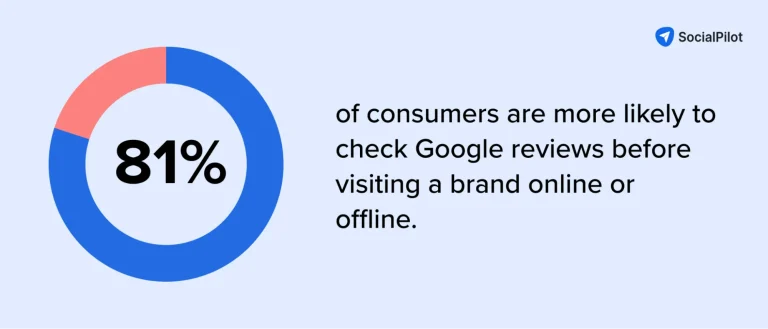
35. 81% of consumers check Google reviews before visiting a business.
36. Google’s share of review readership dropped slightly from 83% to 71% in 2026, but it still leads all platforms by a huge margin.
37. Google removed or blocked over 240 million policy-violating reviews in 2024, up from 170 million the year prior.
38. 67% of consumers trust Google-based reviews the most, followed by Amazon at 47% and Yelp at 41%.

39. 88% of people who perform a local search on a smartphone visit a related store within a week.
That last stat is the one that sells local businesses on review management. Someone searches, reads your reviews, and shows up at your door within days.
Also check: I Tried 25 Testimonial Collection Tools (These 9 Work Best in 2026)
Yelp, TripAdvisor, and Facebook Review Statistics
Google gets the most attention, but these platforms still matter for specific industries.
Yelp
40. Yelp has accumulated over 330 million cumulative reviews.
41. Approximately 52% of Yelp reviews are 5-star reviews.

42. 88% of Yelp users said they trust reviews with written text more than star ratings alone.
43. 57% of customers contact or visit a business they found on Yelp within a day.
TripAdvisor
44. TripAdvisor has accumulated over 2 billion reviews and opinions.
45. 81% of travelers always read reviews before booking a hotel.

46. Only 22% of travelers will post an unsolicited hotel review, which is less than one in four. That means businesses need to actively request feedback.
47. 93% of Facebook users are suspicious of fake reviews on the platform.
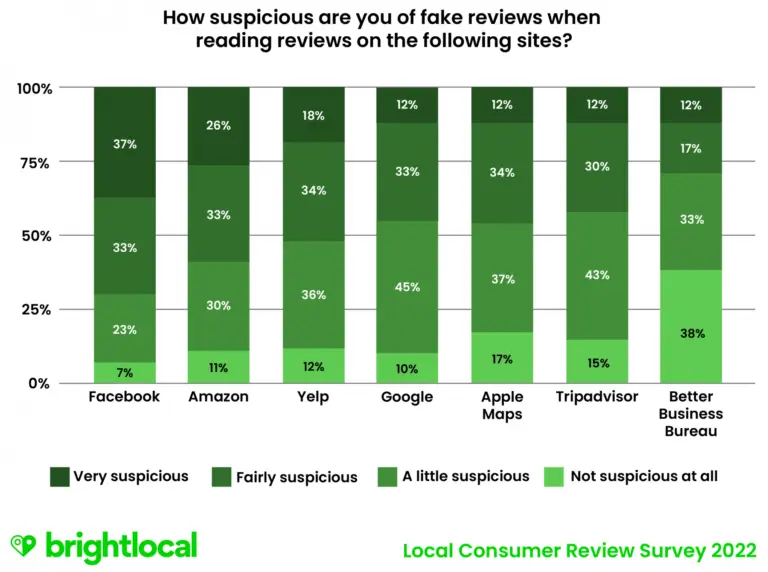
48. Facebook holds about 3% of online customer reviews, down significantly from its peak.
49. Consumer reliance on Facebook for reviews declined from 54% in 2020 to 48% in 2021, and the trend continued downward.
Also check: 15 Genius restaurant review examples with tasty visuals
Amazon Review Statistics
Amazon is its own review ecosystem, and the numbers tell an interesting story.
50. Only 1-2% of Amazon buyers leave reviews after purchasing.
51. A seller would need to sell roughly 10,000 products to receive 100-200 reviews at that rate.
52. Amazon has over 750 million reviews, and an estimated 42% may be fake.
53. 79% of Amazon shoppers are influenced by products with the best ratings and reviews.
54. 56% of consumers said they’d leave a review if they received excellent-quality products.
That 1-2% review rate is something I see store owners struggle with constantly. It’s why automated review request emails exist. If you’re not asking, you’re not getting.
Turn Reviews Into Revenue With WiserReview
AI-powered review insights, 15+ display widgets, automated collection — starting free.
Start Free Trial →Ecommerce Review Statistics
For anyone running an online store, these numbers should be on your wall.
55. Displaying customer reviews can boost sales by 19.8%.
56. Reviews from verified buyers increase conversion by 15%.

57. 25% of consumers find inspiration for new products through customer reviews.
58. 88% of consumers agree that online reviews with written text are more trustworthy than star ratings alone.
59. 62% of consumers are worried that AI might be impersonating individuals and leaving fake product reviews.
60. 96% of customers specifically look for negative reviews to learn how a business addresses issues.

That last one always surprises people. Shoppers aren’t just looking for praise. They want to see how you handle problems. It’s a trust test.
Also check: Customer product reviews & UGC app for ecommerce
Review Statistics by Industry
Review behavior varies a lot depending on the industry. Here’s what the data shows.
B2B Reviews
61. 89% of B2B buyers who use review sites say they often or always check them before buying business software.

62. More than 50% of B2B review site users go through reviews throughout the entire buying process, not just at the start.
63. 30% of all B2B SaaS marketplaces use reviews as social proof to encourage app installs.
Home Services
64. 85% of consumers trust online reviews as much as personal recommendations for local service businesses.

65. 57% of consumers will only use a local business if it has 4 stars or above.
66. Businesses with 4+ star ratings generate 32% more revenue than those with lower reviews.

Travel and Hospitality
67. 72% of travelers worldwide say their booking decisions are influenced by online reviews.

68. 86% of consumers would pass on a good deal from a company with negative reviews.
Healthcare, Legal, and Wellness
69. Two-thirds of consumers in a survey said they’d be more likely to hire a lawyer with online reviews. For millennials (18-35), that number jumps to 81%.

70. 87% of customers will skip any salon or spa with an online rating below 4 out of 5.
Also check: Patient review software for healthcare providers
Fake Review Statistics
This is the dark side of the review world, and it’s getting worse.
71. About 30% of online reviews are estimated to be fake.
72. 82% of consumers have read a fake review in the past year.
73. Fake reviews can mislead consumers, resulting in an estimated $152 billion in losses for honest businesses annually.
74. 88% of consumers who use review platforms are against AI-generated reviews.
75. Google reported the highest fake review rate at 10.7%, followed by Yelp at 7.1% and TripAdvisor at 5.2%.
76. The FTC has increased enforcement, fining over 700 businesses for fabricated endorsements.
77. 75% of consumers are concerned about the authenticity of online reviews.
If you’re collecting reviews honestly, fake reviews are your competition’s problem. But being aware of them helps you understand why consumers are skeptical and why verified buyer badges and transparent review processes matter so much.
Want a deeper look at this topic? Check out our dedicated post on fake review statistics.
AI and the Future of Online Reviews
I can’t write a review statistics post in 2026 without mentioning AI. It’s changing everything.
Consumers are increasingly wary. BrightLocal’s 2026 survey found that the rise of AI-generated content is one reason review-reading habits jumped so dramatically this year. Shoppers are doing more due diligence because they’re not sure what to trust anymore.
Video platforms are gaining ground as non-traditional review sources. YouTube, Instagram, and TikTok are all becoming places where consumers look for authentic opinions. TikTok even launched a Local Explorer program that mirrors Google’s Local Guides.
On the business side, AI is helping too. Review management platforms now use AI to draft response suggestions, detect fake reviews, and analyze sentiment patterns across thousands of reviews.
The direction is clear: authentic, verified reviews from real customers will become more valuable, not less. Businesses that collect genuine customer feedback consistently will have a major advantage over those relying on volume alone.
Also check: 33 Latest user-generated content statistics (New report)
How to Use These Review Statistics for Your Business
Numbers are only useful if you act on them. Here’s what I’d recommend based on everything above:
Ask for reviews consistently. 78% of consumers were asked to leave a review in the past year, and 83% of those actually did. The biggest review generation hack is simply asking.
Respond to every review, especially negative ones. Only 5% of businesses do this. If you do, you’re already ahead of 95% of your competitors.
Focus on recency. 73% of consumers don’t trust reviews older than a month. A steady stream of fresh reviews matters more than a huge pile of old ones.
Don’t stress about perfection. Consumers trust businesses more when they see a mix of positive and negative reviews. A 4.5 rating with honest feedback converts better than a suspicious 5.0.
Use a review management tool. Keeping track of reviews across Google, Facebook, Yelp, and your own site manually is a nightmare. Tools like WiserReview let you collect reviews automatically, manage responses from one place, and display them where they’ll actually drive sales.
Getting Started
The data is clear: online reviews are one of the most powerful tools any business has for building trust and driving revenue in 2026.
The gap between consumer expectations and business behavior is massive. Most shoppers read reviews before buying, but most businesses aren’t even responding to the reviews they receive. That’s an opportunity.
Start by auditing your current reviews across platforms. Set up automated review requests. Respond to your last 10 unanswered reviews today. Small, consistent actions compound fast.
Also check: 77 Shocking online shopping stats by country (2026)
Sources:
Google | Harvard Business School | Yelp | TripAdvisor | Northwestern University Spiegel Research Center | FTC | World Economic Forum | BrightLocal (2026 Local Consumer Review Survey)
Frequently Asked Questions
Common questions about this topic
Written by
Krunal vaghasiya
Krunal Vaghasiya is the founder of WiserReview and WiserNotify, which have served 10,000+ stores since 2020. He helps ecommerce brands build trust through fair, flexible, customer-led review management across every store and market.
Related Articles

57 Latest local SEO statistics (New 2026 data)
Explore 57 latest local SEO statistics. Learn how search trends, reviews, and Google Business Profiles impact visibility and growth.
Krunal vaghasiyaSep 26, 2025
19 Shocking video testimonial statistics (New 2026 data)
New stats show how video testimonials boost trust, raise conversions, and make brands more memorable.
Krunal vaghasiyaSep 11, 2025
12 Must-know testimonial statistics (2026 data)
Discover testimonial statistics that show how reviews influence trust, buying choices, and business growth
Krunal vaghasiyaOct 1, 2025