Discover 21 latest mobile commerce statistics for covering market size, user behavior, payments, conversions, and key global trends shaping mobile shopping.
Mobile shopping has become a regular habit for most people. Customers use their phones to search, compare, and buy products without switching to other devices.
By 2026, mobile is the main way people shop online. Faster apps, easy payments, and better mobile experiences have made phones the preferred choice.
This article shares 21 mobile commerce statistics for 2026 to show how the market is growing and how shopping behavior is changing.
Top highlight
By 2026, mobile commerce will make up ~60% of total global e-commerce sales.
Global mobile commerce revenue is projected to exceed $2.5 trillion.
The Asia-Pacific region accounts for over 55% of global mobile commerce revenue.
Smartphones generate 75–78% of all e-commerce traffic.
Mobile apps account for around 54% of mobile commerce transactions.
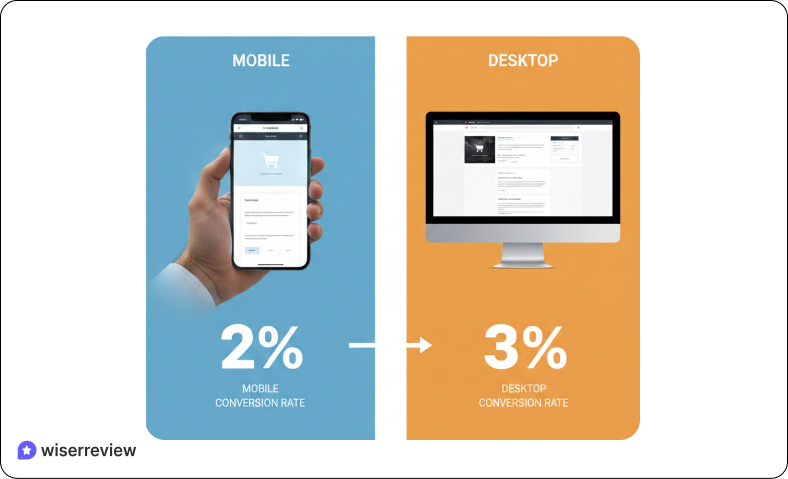
Mobile checkout conversion rates average ~2%, compared to ~3% on desktop.
More than 70% of online shoppers have completed a purchase on mobile.
Digital wallets are used by 5+ billion users globally.
Mobile wallets are projected to process $16 trillion+ in transactions.
Fashion and apparel account for nearly $1 trillion in annual global online sales, with most purchases occurring on mobile.
Overall market size & share
Mobile commerce has grown from a secondary sales channel into the main driver of online shopping worldwide. Smartphones now shape how customers discover products, make decisions, and complete transactions.
What total mobile commerce sales look like
Global mobile commerce sales are projected to exceed $2.5 trillion by 2026, accounting for nearly 60% of total global e-commerce sales.
1. Mobile commerce represents ~60% of global e-commerce sales by 2026.
2. Global mobile commerce revenue is projected to surpass $2.5 trillion.
This growth shows that mobile is no longer catching up to desktop it has already overtaken it.
Over the last decade, mobile commerce revenue has increased more than four times, driven by mobile-first apps, faster internet speeds, and simplified checkout flows.
For many businesses, mobile now generates the largest share of online revenue. Brands that still treat mobile as an add-on rather than a priority risk losing visibility, conversions, and repeat customers.
Regional breakdowns & emerging markets
Mobile commerce adoption varies by region, but growth is consistent across all major markets.
3. Asia-Pacific contributes over 55% of global mobile commerce revenue.
Asia-Pacific leads the world, driven by mobile-first economies where smartphones are the primary digital device.
In countries like China, mobile shopping is deeply integrated into daily life, from payments to social shopping.
4. Mobile commerce accounts for ~45% of online sales in North America, moving steadily toward 50%.
In the United States and Canada, mobile adoption continues to rise as younger shoppers rely more on apps and wallets.
5. Mobile devices drive 55%+ of e-commerce purchases in the UK.
The UK is one of the most mobile-mature markets in Europe.
Emerging markets in India, Southeast Asia, Latin America, and Africa are growing the fastest. In many of these regions, consumers skip desktop entirely and shop only through mobile devices, accelerating mobile-first adoption.
Device/channel breakdown
Smartphones dominate mobile commerce activity at every stage of the funnel.
6. Smartphones generate 75–78% of all e-commerce traffic worldwide.
Mobile traffic continues to grow as consumers spend more time on their phones than on any other device.
7. Mobile apps account for around 54% of mobile commerce transactions.
Apps convert better than mobile browsers due to saved preferences, faster loading times, and one-tap checkout.
Tablets play a minor role compared to smartphones and continue to decline as phones become larger and more powerful.
As a result, most businesses now prioritize mobile-first and app-first strategies.
Consumer Behavior & Adoption
Mobile commerce growth is strongly driven by changes in how people shop, pay, and interact with brands.
Smartphones are now deeply integrated into daily buying decisions, both online and offline.
Mobile shopping penetration
8. More than 70% of online shoppers have completed at least one purchase on mobile.
Mobile shopping is no longer limited to younger users. Shoppers across age groups now rely on phones for convenience, speed, and accessibility.
Consumers increasingly complete the entire buying journey on mobile from product discovery to checkout without switching devices. This shift has changed how brands design product pages, search results, and promotions.
Mobile payments play a major role in reducing checkout friction and increasing conversion rates.
9. Digital wallets are used by 5+ billion users globally.
10. Mobile wallets are projected to process over $16 trillion in transactions.
Mobile wallets allow customers to pay without entering card details, reducing friction and increasing trust. In mobile-first markets, digital wallets are often the default payment method rather than an alternative.
Mobile usage in in-store/omnichannel contexts
Mobile commerce influences offline shopping as well.
11. About 74% of shoppers use their smartphone for product research while inside physical stores.
Customers check reviews, compare prices, and look for discounts while standing in aisles.
Mobile has become the bridge between online and offline shopping, making omnichannel experiences more important than ever.
Conversion, checkout & Mobile UX
Despite driving the majority of e-commerce traffic, mobile still struggles to convert users at the same rate as desktop.
Smaller screens, slower interactions, and complex checkout steps create friction that pushes users away before completing a purchase. Improving mobile user experience remains one of the largest growth opportunities in mobile commerce.
Mobile conversion rates
Mobile shoppers browse frequently but convert less often.
12. Average mobile conversion rates are around 2%, while desktop conversion rates average around 3%.
This gap exists for several reasons. Mobile users are more likely to browse casually, compare prices, or shop while multitasking.
Limited screen space also makes it harder to display product details, trust signals, and checkout steps clearly. Even small delays or confusing layouts can cause users to pause or abandon the purchase entirely.
As mobile traffic continues to rise, even minor improvements in conversion rates can generate significant revenue gains for businesses.
Cart abandonment and checkout friction
Cart abandonment is one of the biggest challenges in mobile commerce.
13. Mobile cart abandonment rates are above 70% on average, higher than on desktop.
The most common reasons mobile users abandon carts include:
Slow page load times
Long or complicated checkout forms
Forced account creation
Poor error handling
Limited payment options
On mobile, users expect speed and simplicity. Any extra step, such as typing shipping details manually or switching apps for payment, creates friction.
This is why checkout optimization has become a priority for mobile-first brands.
Reducing the number of checkout steps and offering guest checkout options can significantly improve completion rates.
Mobile UX factors driving growth
While challenges remain, mobile UX has improved significantly in recent years, helping close the conversion gap.
Key UX improvements driving mobile commerce growth include:
Faster mobile page speeds and optimized images
One-tap and express checkout options
Digital wallets and buy-now-pay-later integrations
Biometric authentication (fingerprint and face ID)
Autofill for addresses and payment details
14. Improving mobile load speed can increase conversion rates by up to 20%.
These improvements reduce effort, increase trust, and make purchasing feel effortless.
As more brands adopt mobile-first design principles and performance optimization, mobile conversion rates are expected to continue improving through 2026.
Emerging technologies & Channels in Mobile Commerce
New tools are changing how people find products and buy on mobile.
Instead of only using product pages and search, shoppers now discover items through social apps, voice assistants, and personalized recommendations.
These changes are making mobile shopping faster and more natural.
Social commerce & Live shopping
15. By 2026, social commerce is expected to account for over 20% of mobile commerce sales in several major markets.
Social apps like Instagram, TikTok, and Facebook now allow users to discover, review, and buy products without leaving the app.
For many shoppers, social feeds are the first place they see new products.
Live shopping adds another layer to this. Brands and creators show products in real time, answer questions, and offer limited deals.
This format works well on mobile because it feels personal, fast, and interactive, especially for younger shoppers.
Voice commerce & Intelligent assistants
16. By 2026, more than 30% of mobile users are expected to use voice assistants for shopping-related actions such as search, reordering, or tracking purchases.
Most voice shopping today focuses on simple tasks like reordering items, checking prices, or finding nearby stores.
While voice is not yet a major checkout channel, it strongly influences mobile shopping decisions.
As voice accuracy improves, it will play a bigger role in product discovery and repeat purchases.
AR/VR and immersive mobile shopping
17. Augmented reality features can reduce product return rates by up to 30%.
AR helps shoppers see how products look before buying. This includes trying on clothes, testing makeup, or viewing furniture in a room using a phone camera.
These tools reduce uncertainty, which is a common problem on small screens. When shoppers feel more confident, they are more likely to buy and less likely to return items.
AI, Personalization & Predictive mobile commerce
18. AI-based personalization can increase mobile conversion rates by 10–15%.
AI helps mobile apps show the right products faster. Instead of browsing long lists, shoppers see recommendations based on past behavior and preferences.
Predictive tools also suggest reorders, send reminders, and show relevant offers at the right time. This makes mobile shopping quicker and more useful for regular customers.
Mobile commerce in specific segments & Regions
Mobile commerce does not grow the same way everywhere. Some regions are already mobile-first, while others are still moving away from desktop.
Product type also matters, as some categories naturally work better on mobile.
Mobile Commerce in the US and UK
19. By 2026, mobile commerce is expected to make up nearly 50% of total online sales in the US.
In the US, mobile shopping grows steadily. Smartphones are widely used for daily purchases, supported by digital wallets and retail apps that offer fast checkout and saved details.
App users usually buy more often than mobile browser users. In the UK, mobile commerce is more advanced. Over 55% of online purchases already happen on mobile.
Strong trust in mobile payments and well-optimized mobile websites helps keep mobile growth high.
Mobile Commerce in asia-pacific & Emerging markets
20. In many Asia-Pacific markets, mobile commerce accounts for over 65% of online sales.
Asia-Pacific leads global mobile commerce. In countries like China, India, and Southeast Asia, smartphones are often the only shopping device.
Super-apps, mobile wallets, QR payments, and live shopping are common.
Emerging markets in Latin America and Africa are also growing fast as smartphone access and mobile payments become more available.
Mobile Commerce by product and Service category
21. Fashion and apparel generate nearly $1 trillion in global online sales, with most purchases now happening on mobile.
Fashion performs best on mobile because visuals, social media influence, and repeat buying fit mobile behavior well.
Other strong mobile categories include beauty products, electronics accessories, food delivery, travel bookings, and groceries, where speed and convenience matter most.
Challenges & Risk areas for Mobile Commerce
Mobile commerce is growing fast, but it also comes with clear challenges.
As more sales happen on smartphones, businesses must deal with security risks, technical issues, and tracking problems that are harder to manage on mobile than on desktop.
Handling these issues is important to protect users and keep sales steady.
Security, Privacy, and App Risks
Security is a major concern in mobile commerce. Mobile apps and browsers store payment details and personal data, which makes them a common target for fraud and data leaks.
With digital wallets used by 5+ billion people worldwide, even small security gaps can affect many users.
Common risks include payment fraud, weak app security, and data privacy issues. To reduce these risks, businesses need strong encryption, biometric login, regular app updates, and clear privacy controls.
Mobile fragmentation and Device issues
Mobile shopping happens across many devices, screen sizes, and operating systems. A site or app that works well on one phone may not work properly on another.
Slow load times, broken layouts, or checkout errors often lead users to leave.
Since smartphones drive over 75% of e-commerce traffic, small technical problems can cause big losses. Regular testing, responsive design, and performance checks are essential.
Mobile marketing and Attribution problems
Measuring mobile performance is harder than desktop. Users move between apps, browsers, social platforms, and devices before buying.
Privacy limits and reduced tracking make it difficult to know which marketing efforts lead to sales.
Many brands now rely on first-party data, basic event tracking, and mobile-focused analytics to better understand user behavior and improve results.
Conclusion
Mobile shopping is now a normal part of everyday life. Most people use their phones to discover products, compare options, and complete purchases quickly and easily.
As mobile usage keeps growing, businesses must focus on fast loading, simple checkout, and smooth mobile experiences. Small improvements in mobile design and performance can make a big difference in sales.
Brands that treat mobile as a priority will be better prepared for future growth, while those that ignore it risk losing customers to faster and easier mobile-first competitors.
Mobile commerce refers to buying products or services using a smartphone or tablet through apps or mobile websites.
Mobile commerce is growing because people spend more time on phones, apps are faster, and payments through digital wallets are quick and easy.
Asia-Pacific leads global mobile commerce, driven by mobile-first users, super-apps, and widespread use of mobile wallets.
Mobile screens are smaller, checkout steps can feel longer, and users often shop while multitasking, which leads to more drop-offs.
Fashion, beauty, electronics accessories, food delivery, travel bookings, and groceries perform best due to visuals, speed, and repeat purchases.
Article by
Krunal
Krunal Vaghasia is the founder of WiserReview and an eCommerce expert in review management and social proof. He helps brands build trust through fair, flexible, and customer-driven review systems. Read more.

 4 min
4 min