4 min
4 min 
Shopify is one of the most popular ecommerce platforms in the world. From small online stores to large global brands, millions of businesses use Shopify to sell products online every day.
As ecommerce continues to grow, data helps explain how Shopify is performing. Statistics show how many merchants use the platform, how much revenue flows through it, and how customers shop and pay.
In this blog, you’ll find key Shopify statistics covering growth, revenue, consumer behavior, store performance, and future trends all in one place.
Top highlight
- Shopify supports ~5 million live stores worldwide
- Shopify merchants operate in 175+ countries
- Over 90% of Shopify merchants are small or medium-sized businesses
- 40,000+ enterprise merchants use Shopify Plus
- Shopify holds ~10–11% of the global ecommerce software market
- Shopify powers ~29% of all US ecommerce websites
- Shopify accounts for 12%+ of total US ecommerce sales
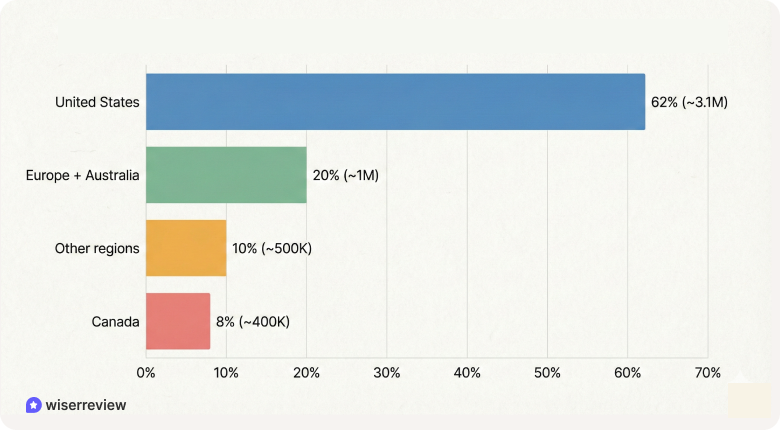
- 62% of Shopify stores are based in the United States
- Canada represents ~8% of Shopify merchants
- Europe and Australia together account for ~20% of merchants
Shopify growth & Market size statistics
Shopify’s growth shows how ecommerce is moving toward easy and scalable platforms. Today, Shopify supports millions of merchants and plays a major role in online retail worldwide.
Its market size is driven by widespread merchant adoption, strong presence in the US, and steady growth across other developed markets.
Total merchants & platform adoption
Shopify is widely adopted by small businesses, startups, and enterprise brands because it is easy to launch, scalable, and supported by a strong ecosystem.
1. Shopify powers around 5 million live stores worldwide.
2. Shopify merchants operate in more than 175 countries.
3. Over 90% of Shopify merchants are small and medium-sized businesses.
Most Shopify stores are run by individuals or small teams, making the platform a strong choice for entrepreneurs and DTC brands.
At the same time, Shopify Plus allows large companies to manage high traffic, global sales, and complex operations. This balance of small and large merchants drives consistent platform adoption.
Shopify’s market share
Shopify holds a strong position in the ecommerce platform market, especially among hosted solutions.
4. Shopify holds approximately 10–11% of the global ecommerce software market.
5. Shopify powers about 29% of all ecommerce websites in the United States.
6. Shopify accounts for over 12% of total US ecommerce sales.
While many platforms compete globally, Shopify dominates the US ecommerce market by both store count and sales volume.
A large number of Shopify stores are active and revenue-generating, which strengthens Shopify’s overall market influence compared to open-source platforms.
Regional growth trends
Shopify’s growth is strongest in developed ecommerce markets, with rising adoption outside North America as well.
7. Canada accounts for about 8% of Shopify merchants globally.
8. Europe and Australia together represent roughly 20% of Shopify merchants.
The United States remains Shopify’s largest market due to high ecommerce spending and strong DTC adoption.
Canada benefits from Shopify’s local presence, while markets such as the UK, Germany, and Australia are growing as businesses shift from custom platforms to simpler hosted solutions.

All your reviews in one place
Collect reviews, manage every response, and display them where they matter most.
Start Free →Shopify revenue & Financial performance statistics
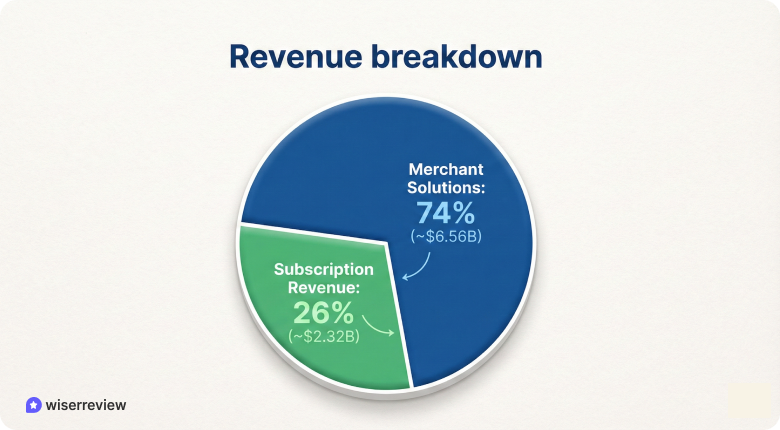
Strong merchant sales, rising payment adoption, and better cost control drive Shopify’s financial growth.
The company earns most of its revenue from subscriptions and merchant services, with payments playing a key role.
Total revenue & revenue segments
Most of Shopify’s income now comes from merchant services such as payments and tools, not just subscriptions.
This shift reflects Shopify’s focus on increasing revenue as merchants grow.
9. Shopify generated $8.88 billion in total revenue in 2024.
10. Revenue grew by 26% year over year in 2024.
11. Shopify earned $7.06 billion in revenue in 2023.
12. Merchant solutions contribute about 74% of Shopify’s total revenue.
13. Subscription revenue accounts for roughly 26% of total revenue.
Profitability & expenses
After reducing logistics-related costs, Shopify improved efficiency. Higher sales volume and controlled spending helped strengthen overall financial performance.
14. Shopify’s GMV reached $292.3 billion in 2024.
15. GMV grew by approximately 24% year over year.
16. Operating margins improved in 2024 due to lower expenses.
Shopify Payments statistics
Built-in payments reduce checkout friction and increase conversion, especially on mobile.
Shopify Payments has become a major driver of revenue and merchant growth.
17. Shopify Payments is available in 20+ countries.
18. Over 70% of Shopify merchants use Shopify Payments.
19. Shop Pay checkout converts up to 1.7× better than standard checkout.
Shopify merchant demographics
Shopify merchants come from many industries and regions, but small businesses and direct-to-consumer brands mainly use the platform.
Understanding who sells on Shopify helps explain how the platform grows.
Business size distribution
20. About 90% of Shopify merchants are small businesses with fewer than 10 employees.
21. Less than 5% of Shopify merchants are large or enterprise-level businesses.
Solo founders or small teams run most Shopify stores. This shows that Shopify is built primarily for entrepreneurs, even though it also supports large brands through Shopify Plus.
Top industries on Shopify
22. Apparel and accessories account for roughly 25% of all Shopify stores.
23. Health, beauty, and personal care represent about 10% of stores.
Fashion leads Shopify because it fits well with direct-to-consumer selling.
Health and beauty brands are growing fast due to repeat purchases and strong brand loyalty.
Merchant location statistics
24. Approximately 62% of Shopify merchants are based in the United States.
25. Canada, the UK, and Australia together account for approximately 18% of merchants.
North America remains Shopify’s strongest market. However, English-speaking countries outside the US continue to adopt Shopify as ecommerce demand increases.
Shopify consumer behavior statistics
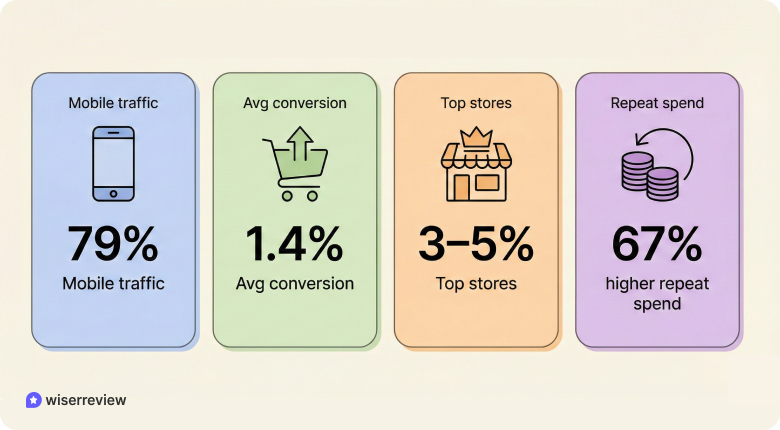
Shopper behavior on Shopify shows how customers browse, buy, and return to stores. Mobile usage, conversion rates, and repeat purchases all play a significant role in store performance.
Conversion rates
Most Shopify stores convert at a modest rate, but stores with strong design, fast checkout, and clear offers perform far better than average.
26. The average Shopify store conversion rate is around 1.4%.
27. Top-performing Shopify stores reach conversion rates of 3% to 5%.
Mobile commerce trends
28. About 79% of Shopify traffic comes from mobile devices.
29. Mobile devices generate over 60% of Shopify sales.
Mobile shopping dominates Shopify. Stores that are not optimized for mobile speed and usability often lose sales, especially during checkout.
AOV & repeat customer behavior
30. The average order value on Shopify ranges from $85 to $110.
31. Repeat customers spend about 67% more than first-time buyers.
Higher AOV and repeat purchases are key to long-term growth.
Loyalty programs, email marketing, and smooth post-purchase experiences help increase customer lifetime value.



All your reviews in one place
Collect reviews, manage every response, and display them where they matter most.
Shopify app store & Integrations statistics
The Shopify App Store is a major reason merchants choose Shopify.
Apps help stores add features, automate work, and improve marketing without custom development.
App store size & usage
32. The Shopify App Store has more than 11,900 active apps.
33. Around 87% of Shopify merchants use at least one app.
Most Shopify stores rely on apps to extend functionality. Marketing, conversion optimization, and analytics apps are the most commonly installed.
App revenue insights
34. Shopify app developers have earned over $1.5 billion in total revenue.
35. Top Shopify apps generate millions of dollars annually.
The app ecosystem is profitable for developers and valuable for merchants. High-performing apps often solve specific problems, such as reviews, upsells, or subscriptions.
Integration trends
As stores grow, they add more integrations for marketing, fulfillment, and customer support. Managing app performance becomes critical to avoid slow store speeds.
36. The average Shopify store uses about 6 apps.
37. Large Shopify stores often use 15–20 integrations.
Shopify themes, store performance & UX statistics
Store design, page load speed, and user experience directly impact Shopify sales. Even minor improvements in speed and usability can significantly increase conversions.
Store speed & performance
38. A 1-second delay in page load time can reduce conversions by about 7%.
39. Shopify stores that load in under 2 seconds convert significantly better.
Fast-loading stores keep shoppers engaged and reduce bounce rates. Speed is essential on mobile, where slow sites lead to lost sales.
Theme adoption
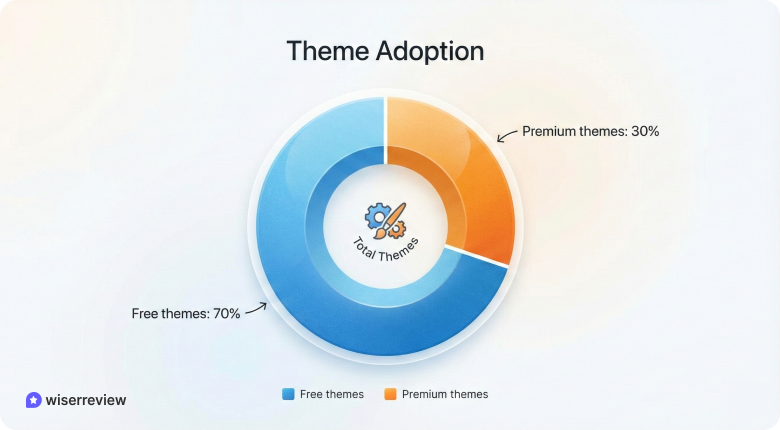
40. More than 70% of Shopify merchants use free themes.
41. Premium themes are most commonly used by mid-size and large stores.
Free themes are popular because they are easy to set up and well-optimized. Growing brands often switch to premium or custom themes to improve branding and flexibility.
UX elements & impact
42. Simplified checkout can reduce cart abandonment by 10–15%.
43. Mobile-optimized UX improves conversion rates by around 20%.
Straightforward navigation, fewer checkout steps, and a mobile-first design help customers complete purchases faster.
Good UX is one of the easiest ways to increase revenue without extra traffic.
Shopify Plus (Enterprise) statistics
Shopify Plus is designed for high-volume and fast-growing brands. It supports complex operations, global sales, and high order volumes while maintaining Shopify’s ease of use.
Shopify Plus adoption
More large brands are choosing Shopify Plus as an alternative to custom or legacy ecommerce platforms. Scalability and lower maintenance costs are key reasons for adoption.
44. Shopify Plus is used by more than 40,000 enterprise merchants worldwide.
45. Shopify Plus adoption has grown by over 20% year over year.
Industry breakdown
Direct-to-consumer brands dominate Shopify Plus, especially in fashion and beauty, where branding, speed, and omnichannel selling are critical.
46. Fashion and apparel brands make up about 60% of Shopify Plus merchants.
47. Consumer goods and beauty brands account for roughly 20% of Plus stores.
Shopify Plus revenue insights
48. Shopify Plus stores generate 3–5× higher average order value than SMB stores.
49. Enterprise merchants contribute a significant share of Shopify’s total GMV.
Although Plus merchants are fewer in number, they generate much higher sales volumes.
This makes Shopify Plus a key driver of Shopify’s long-term revenue growth.
Shopify shipping, fulfillment & Logistics statistics
Shipping speed, delivery cost, and fulfillment reliability strongly affect customer satisfaction on Shopify. Shopify supports merchants with built-in shipping tools and its own fulfillment network.
Shopify fulfillment network
50. Shopify Fulfillment Network (SFN) operates across the United States and Canada.
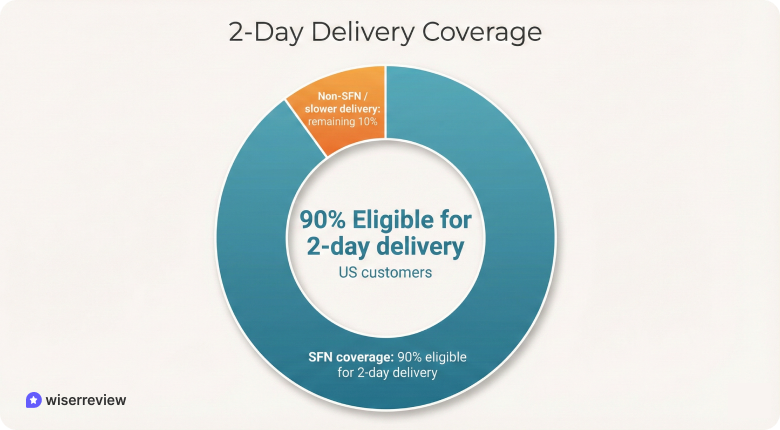
51. SFN enables 2-day delivery coverage for over 90% of US customers.
Shopify Fulfillment Network helps merchants compete with large marketplaces by delivering orders quickly and reliably.
It is primarily used by growing and enterprise-level merchants seeking simplified logistics.
Shipping costs & delivery trends
52. High shipping costs cause about 48% of cart abandonments on Shopify stores.
53. Stores offering free or discounted shipping see up to 30% higher conversion rates.
Customers expect fast and affordable shipping. Many Shopify merchants use free shipping thresholds or flat-rate pricing to reduce cart abandonment and improve checkout completion.
All your reviews in one place
Collect reviews, manage every response, and display them where they matter most.
Start Free →Shopify marketing & Advertising statistics
Marketing plays a significant role in driving growth for Shopify stores. Merchants rely on SEO, paid ads, and owned channels like email and SMS to drive traffic and repeat sales.
SEO performance
54. Organic search drives around 33% of total traffic to Shopify stores.
55. Shopify stores with blogs generate up to 55% more organic traffic.
SEO is a long-term traffic source for Shopify merchants. Content marketing, optimized product pages, and fast site speed help stores rank better in search results.
Paid advertising usage
56. Over 65% of Shopify merchants use paid advertising channels.
57. Facebook and Instagram ads account for more than 40% of paid traffic.
Paid ads are widely used to acquire new customers. Social platforms remain the top choice for Shopify brands, especially for product discovery and retargeting.
Email & SMS marketing adoption
58. Email marketing delivers an average ROI of up to 36× for Shopify merchants
59. SMS campaigns on Shopify see average click-through rates of 6–8%
Email and SMS are highly effective because they reach customers directly. These channels are commonly used for promotions, abandoned cart reminders, and repeat purchases.
Shopify security, checkout, & Payment behavior statistics
Security and checkout experience directly affect trust and conversions on Shopify stores. Shopify focuses heavily on fast checkout, secure payments, and fraud protection to reduce purchase friction.
Checkout experience
Long or complex checkout processes lead to cart abandonment. Shopify encourages fewer checkout steps, guest checkout options, and faster payment methods to improve completion rates.
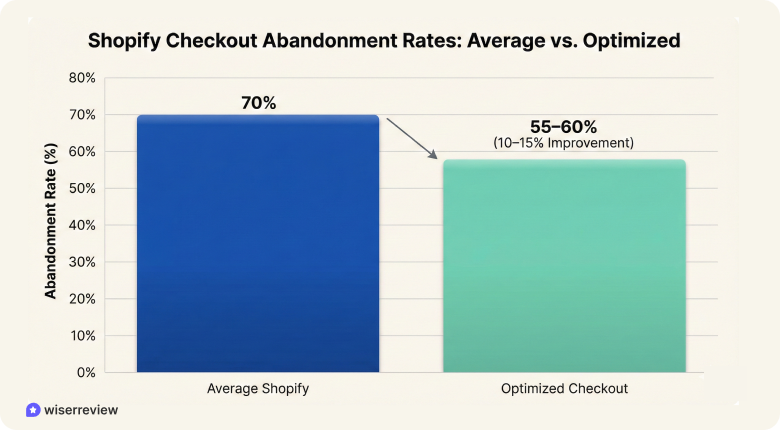
- Average cart abandonment rates on Shopify stores are around 70%
- Simplified checkout experiences can reduce abandonment by 10–15%
- Stores that use accelerated checkout options convert significantly more than those that use standard checkouts.
Shop Pay performance
Shop Pay securely stores customer information, enabling faster repeat purchases. This is especially effective on mobile devices, where typing payment details slows users down.
- Shop Pay converts up to 1.7× higher than traditional guest checkout.
- Shop Pay is available to shoppers in multiple major ecommerce markets.
- Mobile shoppers are more likely to complete purchases using Shop Pay
Security data
Security is handled at the platform level, reducing risk for merchants. Shopify’s infrastructure protects customer data and enables merchants to operate securely without managing complex security systems.
- Shopify is PCI DSS Level 1 compliant.
- Shopify processes billions of secure transactions annually
- Built-in fraud analysis tools help merchants reduce chargebacks
Shopify sustainability & Social impact statistics
Sustainability and ethical practices are becoming more important for ecommerce brands. Shopify supports merchants in promoting eco-friendly initiatives and social responsibility.
Sustainable brand adoption
Many Shopify brands highlight eco-friendly packaging, ethical sourcing, and carbon-neutral shipping to attract conscious consumers.
- Over 30% of Shopify brands actively promote sustainability initiatives.
- Thousands of Shopify merchants participate in carbon offset programs.
Consumer preferences
Sustainability influences purchasing decisions. Shopify merchants that communicate social impact often see stronger brand loyalty and trust.
- More than 60% of online shoppers prefer brands that prioritize sustainability.
- Consumers are willing to pay up to 10% more for products from responsible brands.
Future predictions for Shopify
Shopify’s future growth will depend on ecommerce trends, technology adoption, and merchant expectations. The platform is expected to evolve beyond basic online stores.
Ecommerce trends impacting Shopify
Mobile-first shopping, social platforms, and global selling will shape how Shopify merchants operate. Brands that adapt early will gain a competitive advantage.
- Mobile commerce is expected to account for over 70% of ecommerce sales.
- Social commerce sales are projected to grow by 20%+ annually.
- Cross-border ecommerce continues to expand year over year
Shopify roadmap expectations
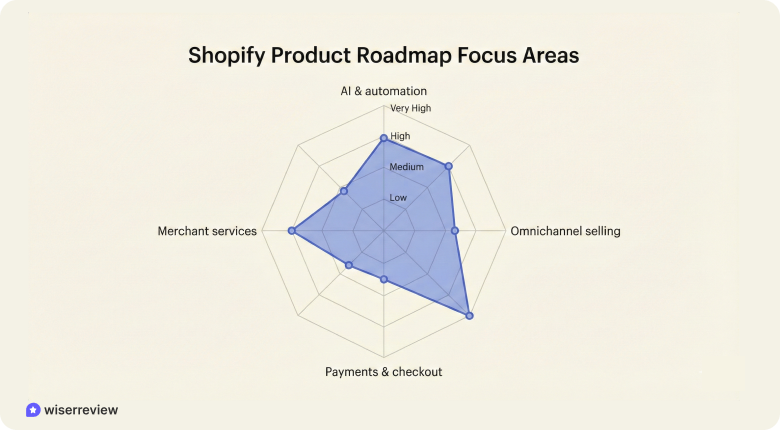
Shopify is expected to simplify complex ecommerce tasks using automation and AI while expanding its ecosystem to support omnichannel selling.
- Increased focus on AI-powered tools for marketing and operations
- Deeper integrations across online, retail, and social commerce
- Continued investment in payments, checkout, and merchant services
All your reviews in one place
Collect reviews, manage every response, and display them where they matter most.
Start Free →Conclusion
Shopify remains a powerful platform for businesses selling online. It supports millions of merchants and plays a major role in global ecommerce growth.
The data shows that speed, mobile experience, checkout simplicity, and repeat customers strongly impact store success. Small improvements in these areas can lead to better conversions and higher revenue.
As ecommerce continues to evolve, Shopify is expected to focus more on automation, payments, and global selling to help merchants grow more efficiently.
Also see:
Frequently asked questions
Shopify powers millions of live stores across the world, serving small businesses, startups, and large brands in many countries.
Shopify is one of the most widely used hosted ecommerce platforms and powers a large share of online stores, especially in the United States.
Most Shopify stores have an average conversion rate of around 1–2%, while top-performing stores can reach 3–5% with strong design and fast checkout.
Most Shopify traffic and sales come from mobile devices, making mobile speed, design, and checkout critical for conversions.
Shopify helps merchants grow through fast checkout, built-in payments, mobile optimization, app integrations, and tools that improve customer experience.

Krunal