8 min
8 min 
The choice between BigCartel and Etsy depends on how you want to sell and how much control you need.
BigCartel works best if you want a simple store you own and manage yourself. Etsy is better for those wanting built-in traffic and are comfortable with marketplace rules and fees.
It all depends on whether you want quick sales or long-term brand ownership.
This guide shows the real differences that sellers feel after months of use, not marketing claims. Read on to see which platform actually fits your selling style and growth plans.
Quick comparison: BigCartel vs Etsy
Here are the main differences between BigCartel and Etsy.
| Feature | BigCartel | Etsy |
|---|---|---|
| Platform type | Standalone ecommerce site | Online marketplace |
| Audience | Sellers must bring their own traffic | Access to millions of built-in shoppers |
| Customization | High. Custom themes with HTML and CSS access | Limited. Fixed layout under Etsy’s brand |
| Pricing model | Monthly subscription with a free plan | Free to join with per-sale fees |
| Listing fee | None | $0.20 per item, renews every 4 months |
| Transaction fee | None, only payment processor fees | 6.5% transaction fee plus payment processing |
| Best for | Artists who want brand control and independence | Artisans who want fast exposure and traffic |
Pricing and fees
Understanding what you’ll actually pay makes or breaks your profit margins. Let’s break down where your money goes on each platform.
BigCartel pricing model
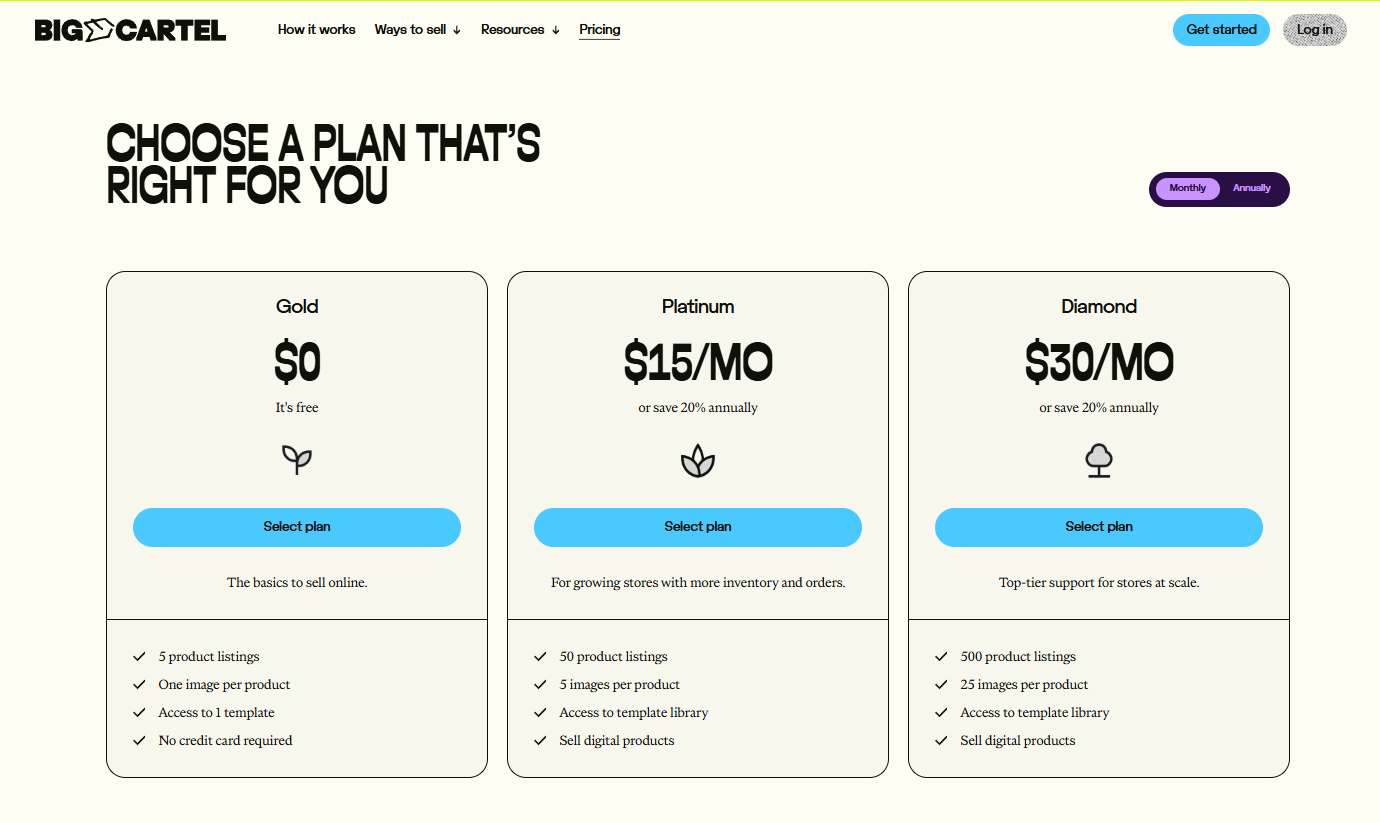
BigCartel’s pricing is pretty straightforward; it uses a monthly subscription tier with a limit on the number of products you can list.
Monthly Subscription: Plans are tiered by the number of products included, with a free plan available.
- Gold Plan: Free (up to 5 products).
- Platinum Plan: $15/month (up to 50 products).
- Diamond Plan: $30/month (up to 500 products).
Transaction Fees: None.
Payment Processing Fees: BigCartel does not charge these; sellers only pay the standard fees from third-party processors like PayPal or Stripe (typically around 3% + $0.25 per transaction in the U.S.).
Other Fees: No hidden fees. No mandatory advertising costs.
Etsy pricing model
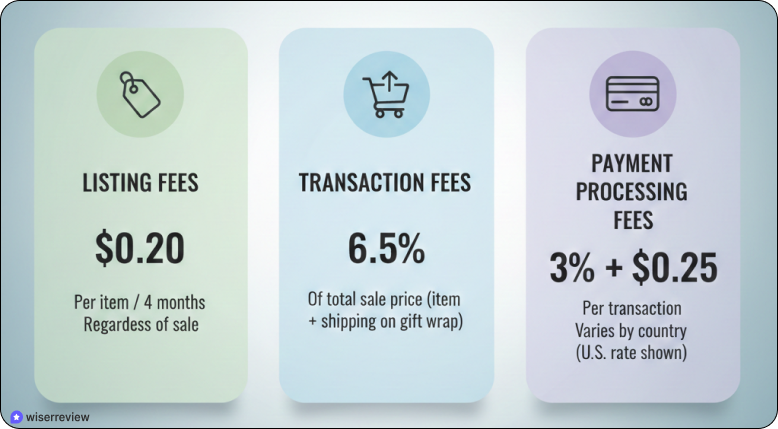
Etsy operates on a pricing model that takes a commission on almost everything that happens on the platform – and that’s a lot, if you’re a seller.
Listing Fees: There’s a $0.20 charge per item whenever you list something – it doesn’t matter if it sells or not, and listings expire after four months.
Transaction Fees: Then there’s a 6.5% cut of the sale price, including shipping and any gift wrapping fees.
Payment Processing Fees: If you use Etsy Payments (which is the default), you’ll have to pay a small fee on top – in the US, that’s 3% + $0.25 per transaction. But rates vary by country.
Optional/Variable Fees:
Offsite Ads: If you get sales from ads running on external sites like Google or social media – well, you’re charged extra (15% for shops under $10k/year, 12% for those above it).
Etsy Plus Subscription: want some extra features and credits? That’ll be $10/month.
Currency Conversion Fees: if you list in a currency different to your bank account, that’s 2.5% coming out of your pocket.
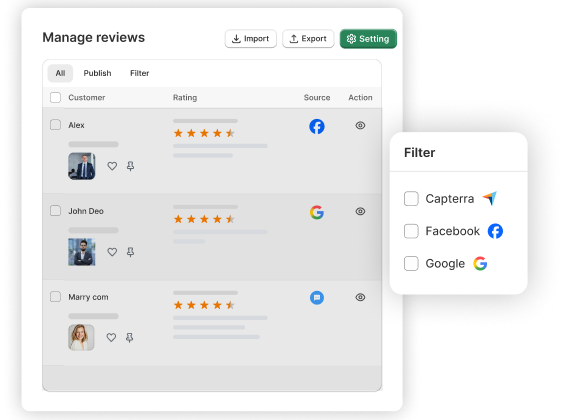
All your reviews in one place
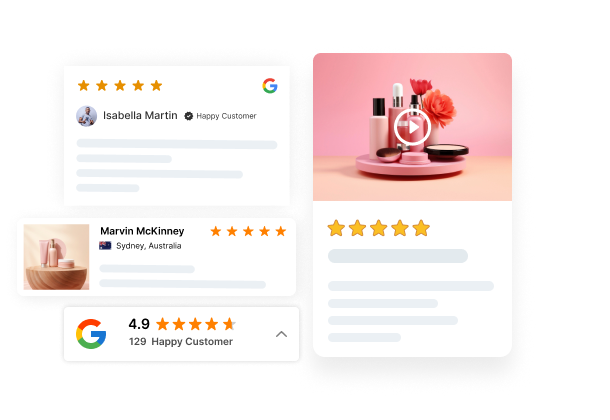
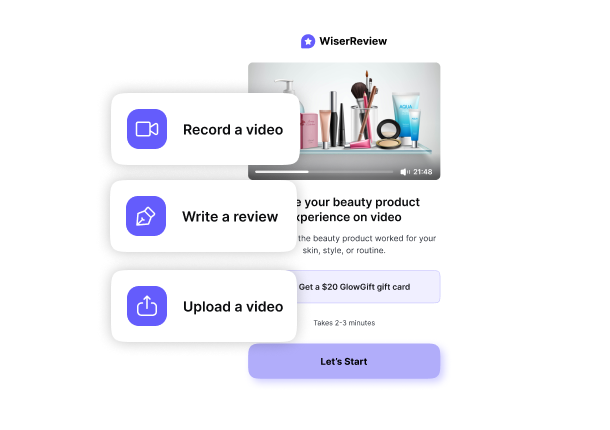
Collect reviews, manage every response, and display them where they matter most.
Business model and audience reach
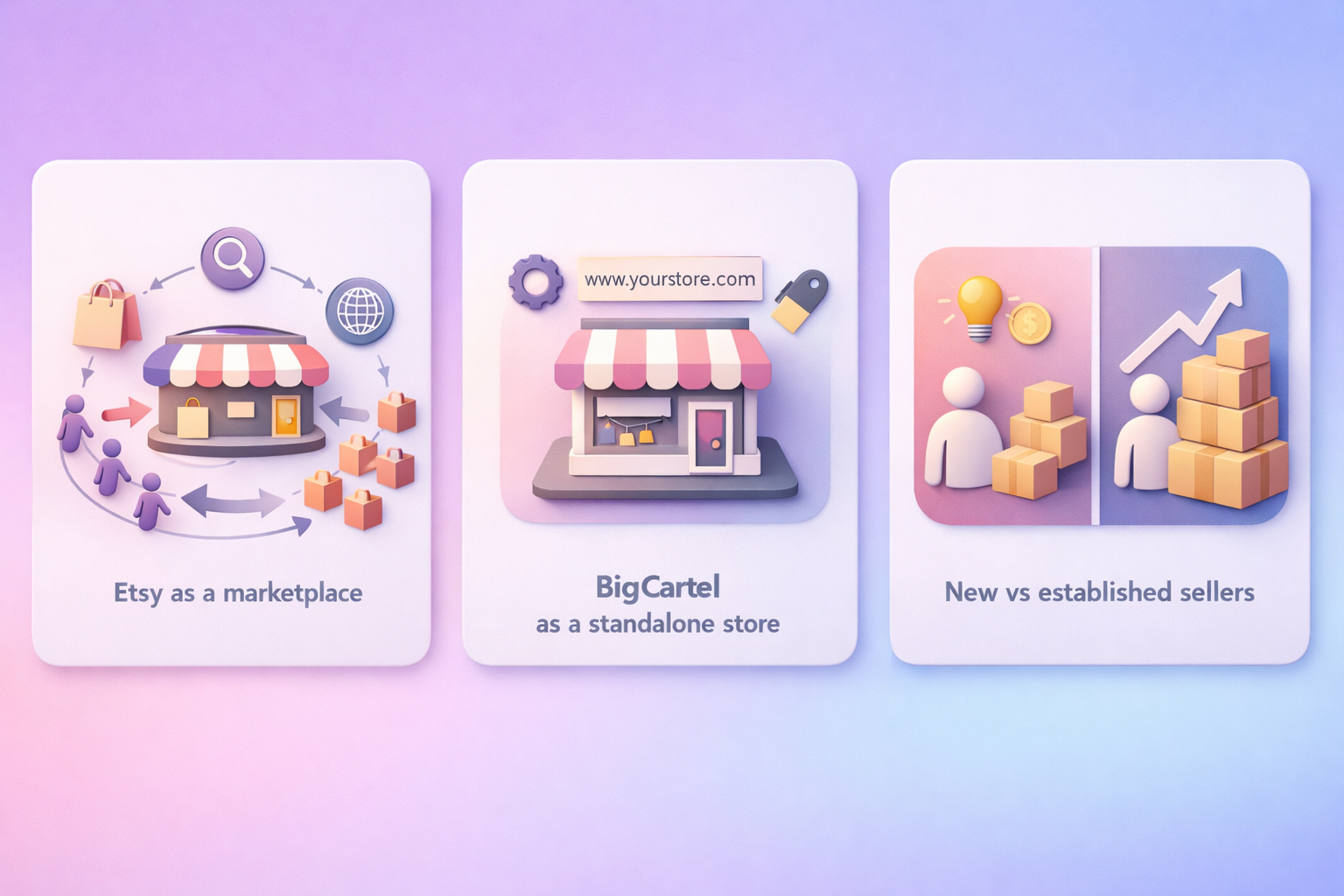
What distinguishes these platforms is not primarily the price but how the customer finds and buys from you.
Etsy as a marketplace
Etsy is a peer-to-peer marketplace that connects millions of buyers and sellers of handmade, vintage, and unique goods.
- Audience Reach: Etsy has a massive, established global audience of nearly 90 million active buyers, many of whom are actively searching for unique products. This means products can gain visibility without extensive external marketing efforts.
- Business Model: Etsy acts as a facilitator, earning revenue through various fees (listing, transaction, payment processing, advertising) rather than selling its own inventory.
But here’s the catch: When someone buys from you, they’re buying “on Etsy,” not from your brand. Customer loyalty comes first in the marketplace.
BigCartel as a standalone store
With Big Cartel, you have your own self-contained Internet storefront. Choose your domain name (yourstore.com), control the whole shopping experience, and nurture the customer relationship.
- Audience reach: BigCartel doesn’t come with an audience or an organic reach. The vendor must attract visitors through all available channels, including marketing, social media, and SEO.
- Business model: Big Cartel has a simple and very low monthly subscription fee with no listing and/or transaction charges. This leaves you with a higher profit share.
What this means for new vs established sellers
Starting from zero? Etsy is excellent for new sellers who want a fast, low-cost setup and immediate access to potential customers to validate their products. The platform’s built-in trust and infrastructure simplify the initial selling process.
Building a real brand? BigCartel gives you ownership. It is a great, budget-friendly option for beginners or hobbyists selling only a few products, who prioritize brand identity and creative control over immediate sales volume.
Many successful sellers use both Etsy for discovery and quick sales and BigCartel for brand building and higher profit margins.
Branding, design, and customization
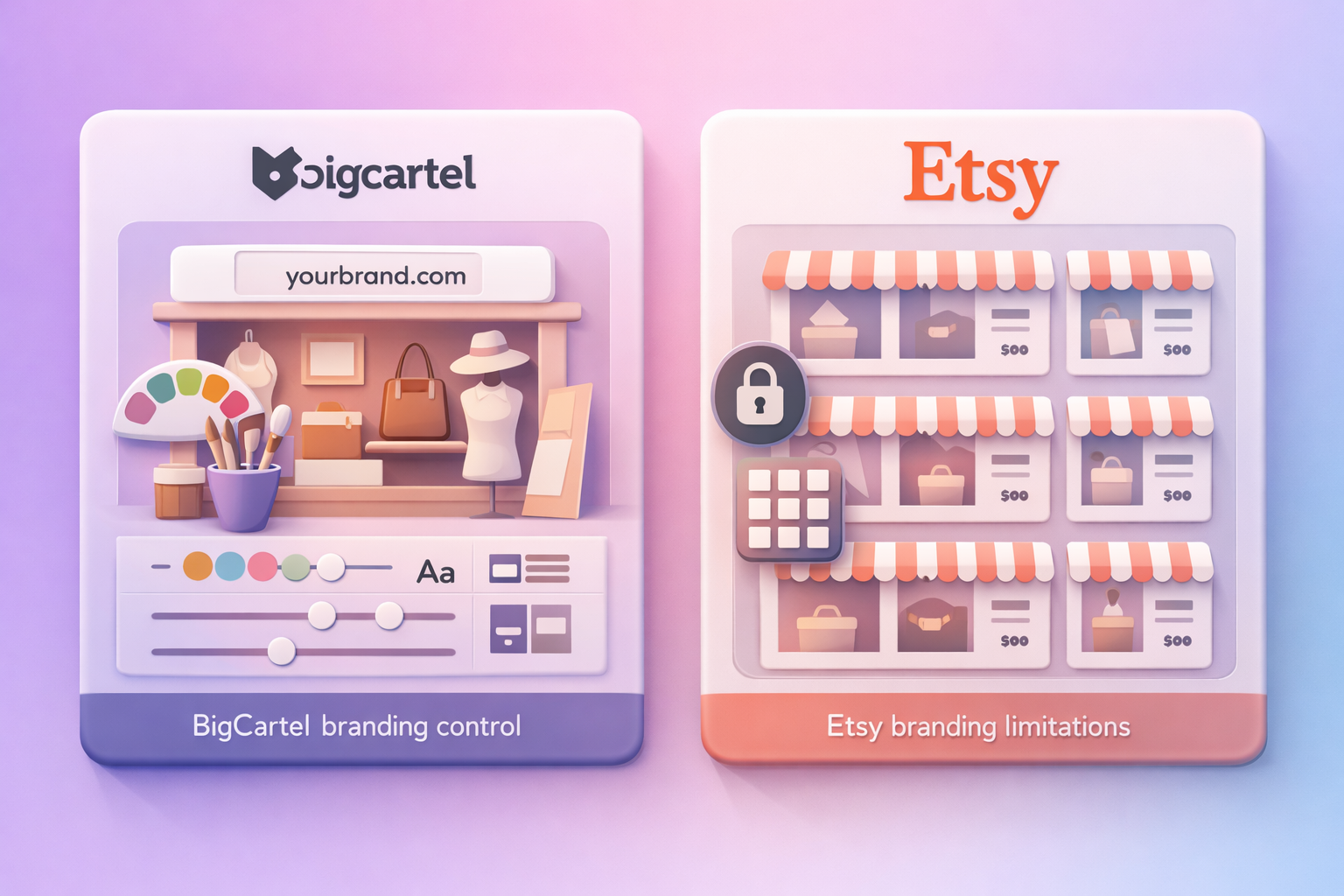
BigCartel offers greater branding control, allowing sellers to build their own independent online presence, while Etsy has limited branding and design options, limiting sellers to a standardized marketplace layout.
BigCartel branding control
BigCartel is all about giving creators the tools they need to build a unique brand and website.
- Total Control: You’ve got a high degree of control over your store’s look and feel, like you’re running your own boutique.
- Customization Options: There are loads of customizable themes to choose from – and on paid plans, you can dig deep into the HTML and CSS to get really creative.
- Custom Domain: Paid plans allow sellers to use a custom domain (e.g., yourbrand.com), which is crucial for professional branding and search engine optimization (SEO).
The platform offers no-code customization through simple settings, plus advanced HTML/CSS editing for those who want deeper control.
Etsy branding limitations
Etsy, on the other hand, has a pretty limited range of customization options – you can change some colors and fonts, and upload a logo and banner, but that’s about it. Shops look pretty similar as a result.
- Fixed Layout: Shops live inside Etsy’s standard layout, with barely any chance to get creative.
- Basic Customization: You can upload a shop icon, profile photo and banner – but that’s less for changing the look and feel.
- No Code Access: You can’t touch the HTML and CSS, which means no real deep-level customization.
- Etsy’s Branding Dominates: When customers buy something from you, they often say “I got it from Etsy” – which means the marketplace’s brand is what they remember, not yours.
For serious brand building, tools like WiseReview are essential. That’s a fancy way of saying reviews, WiseReview helps you collect them, keep them organized, and put them where they’ll do the most good.

All your reviews in one place
Collect reviews, manage every response, and display them where they matter most.Long-term brand value comparison
The choice between the two platforms significantly impacts a seller’s long-term brand-building efforts:
BigCartel: Offers much greater long-term brand value. By building an independent website with a unique domain and design, the seller is investing in their own sellable asset.
Etsy: Provides immediate visibility and traffic, which is great for short-term sales and product validation. However, in the long term, the seller is largely building the “Etsy” brand, not their own.
The lack of control and intense competition make it harder to stand out and build an independent, recognizable brand identity.
Products, listings, and catalog limits
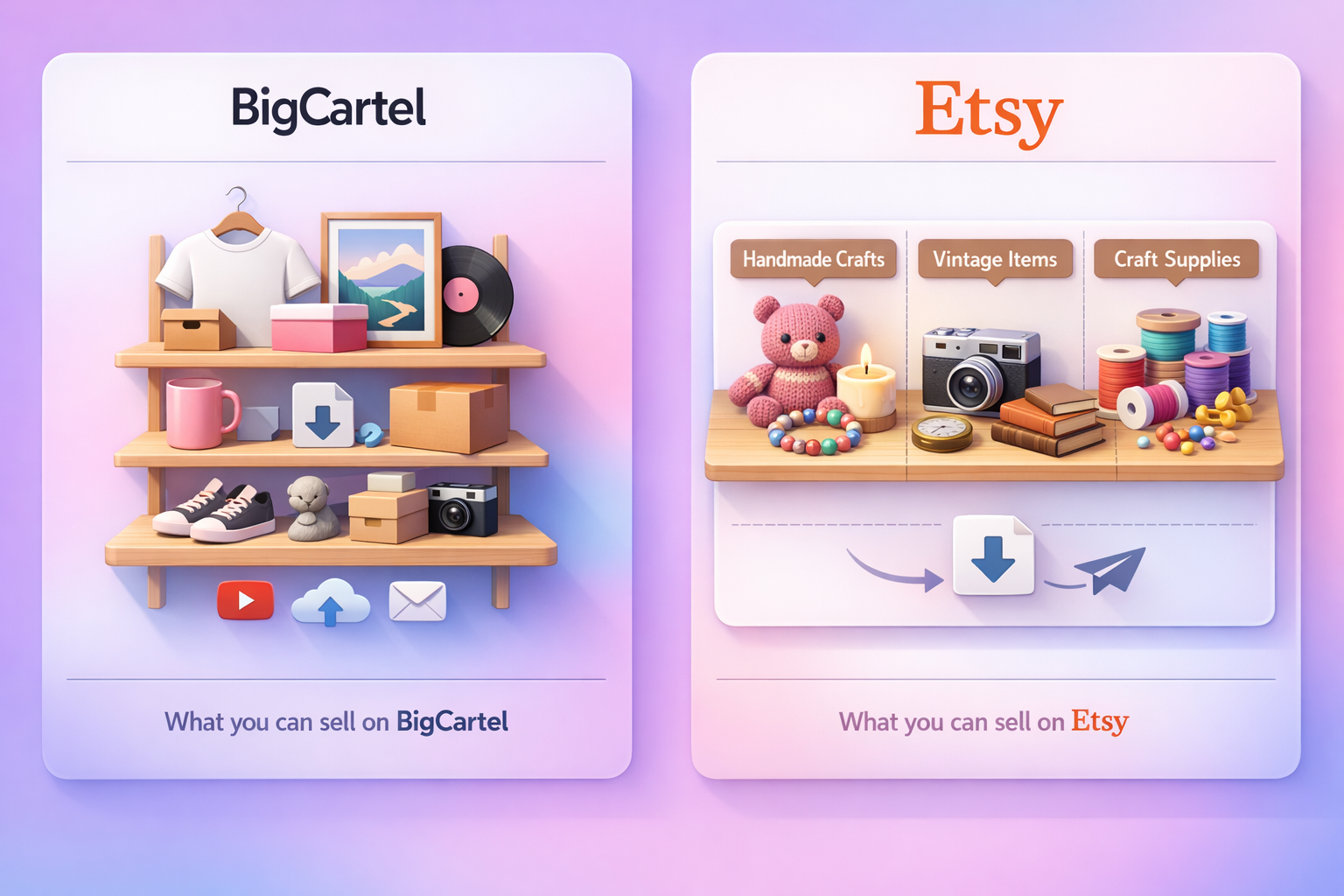
What you can sell and how many items you can list vary significantly between platforms.
What you can sell on BigCartel
BigCartel welcomes any legal product, handmade goods, print-on-demand, digital downloads (with integrations), vintage items, or manufactured products.
No restrictions on product types. The platform primarily supports physical products, with digital product sales available through integrations such as Pulley.
You can sell digital products, but this feature is typically reserved for paid plans or requires a third-party app integration (such as Pulley) to securely manage file delivery.
What you can sell on Etsy
You are generally limited to three specific categories.
- Handmade: Items made or designed by you. Reselling (selling items you didn’t design or make) is strictly prohibited in this category.
- Vintage: Items must be at least 20 years old.
- Craft Supplies: Tools, ingredients, or materials used to create other items (can be handmade or commercial).
Native support for digital downloads (e.g., printable planners, art) is built into the platform. It automatically delivers the file upon purchase.
Product limits and scalability
| Feature | BigCartel | Etsy |
|---|---|---|
| Listing Limit | Capped. Strict limits based on subscription: Free: 5 products, Paid: 50 or 500 products | Unlimited. You can list as many items as you want. |
| Listing Cost | Free. No fee to list an item, but you are limited by your plan cap. | $0.20 per item. You pay this every time you list an item or renew a sold/expired listing. |
| Scalability | Limited. Best for “drops” or boutique collections. The 500-product ceiling makes it unsuitable for massive inventories. | High Volume. Can handle thousands of SKUs, but listing fees and transaction fees (6.5%) scale directly with your volume. |
Traffic, marketing, and discovery
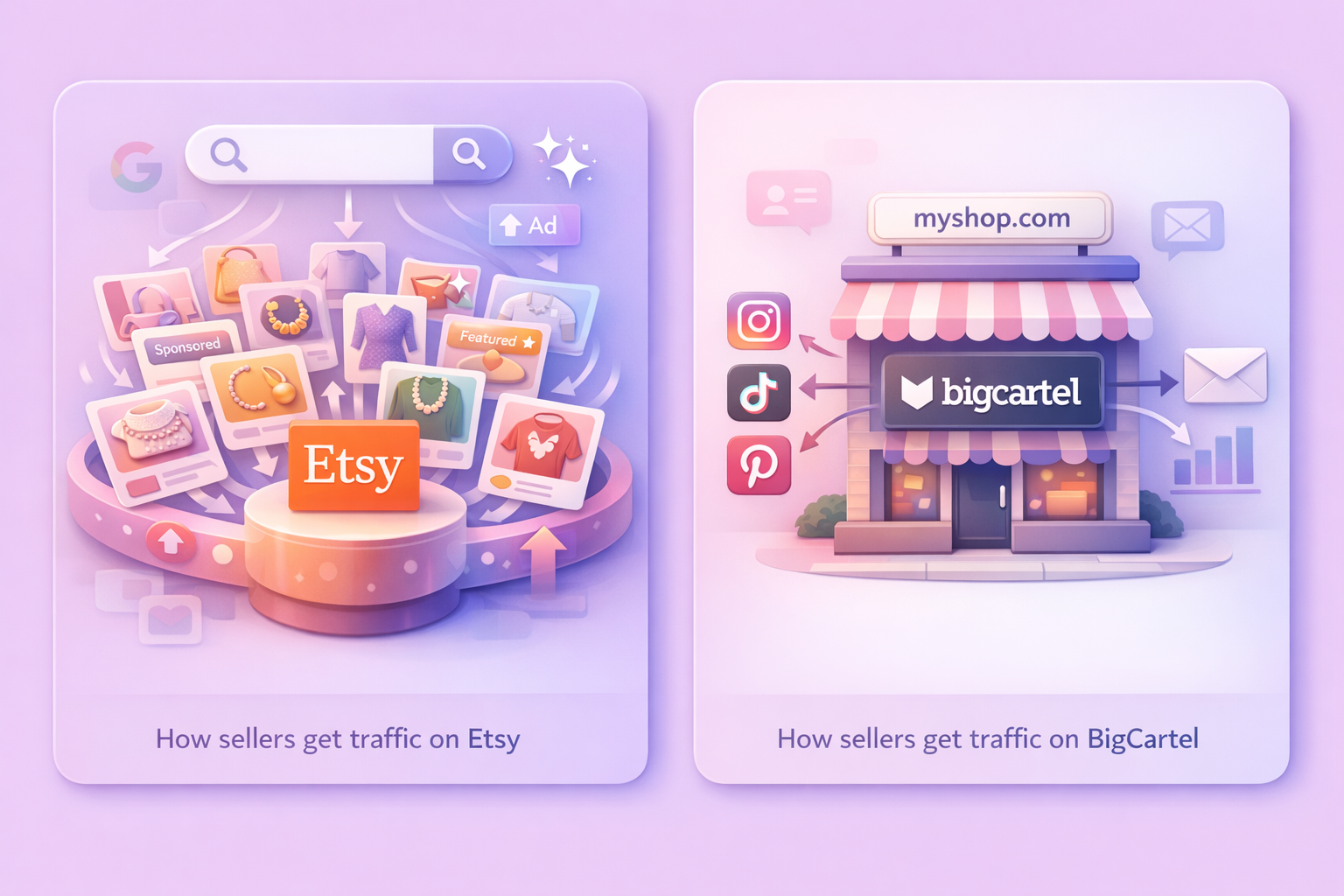
Getting customers to your store determines everything. Here’s how each platform handles customer acquisition.
How sellers get traffic on Etsy
Etsy operates as a discovery engine, using several internal mechanisms to surface products to its roughly 90 million active buyers.
- Marketplace Search (SEO): This is the core of how Etsy works, and it’s an algorithm that prioritizes natural language and listing quality.
- Built-in Discovery Tools: Features like “Gift Mode” use AI to match buyers with relevant stuff – based on what you’ve written in your titles and attributes.
- On-site Etsy Ads: Sellers can pay to have their listings appear at the top of search results and category pages. These typically cost between $0.20 and $0.50 per click.
- Offsite Ads: Etsy automatically advertises listings on external platforms like Google and Instagram.
How sellers get traffic on BigCartel
BigCartel is a standalone store builder, so it is not indexed by search engines by default. Sellers must actively market their specific URL to find customers.
- Social Media Marketing: Most BigCartel sellers rely on platforms like Instagram, TikTok, and Pinterest to build a following and drive traffic directly to their site.
- Email Marketing: Sellers often use newsletters (via integrations like Mailchimp) to re-engage past customers. Paid plans include abandoned cart recovery to bring back lost shoppers.
- Paid Ad Integrations: With BigCartel you can run and measure your own independent ad campaigns using native support for tracking pixels (Facebook, TikTok, Pinterest) – it’s all about being able to track how your ads are doing.
BigCartel lets you integrate with marketing tools, but it doesn’t provide traffic on its own. And that’s actually a big benefit – when customers find you, they’re finding your brand, not a marketplace.
This is where building trust becomes really, really important. Using WiseReview to show off customer testimonials on your BigCartel store, social media, and marketing materials is a big help in converting the traffic that you work so hard to generate.
All your reviews in one place
Collect reviews, manage every response, and display them where they matter most.
Payments, checkout, and selling experience
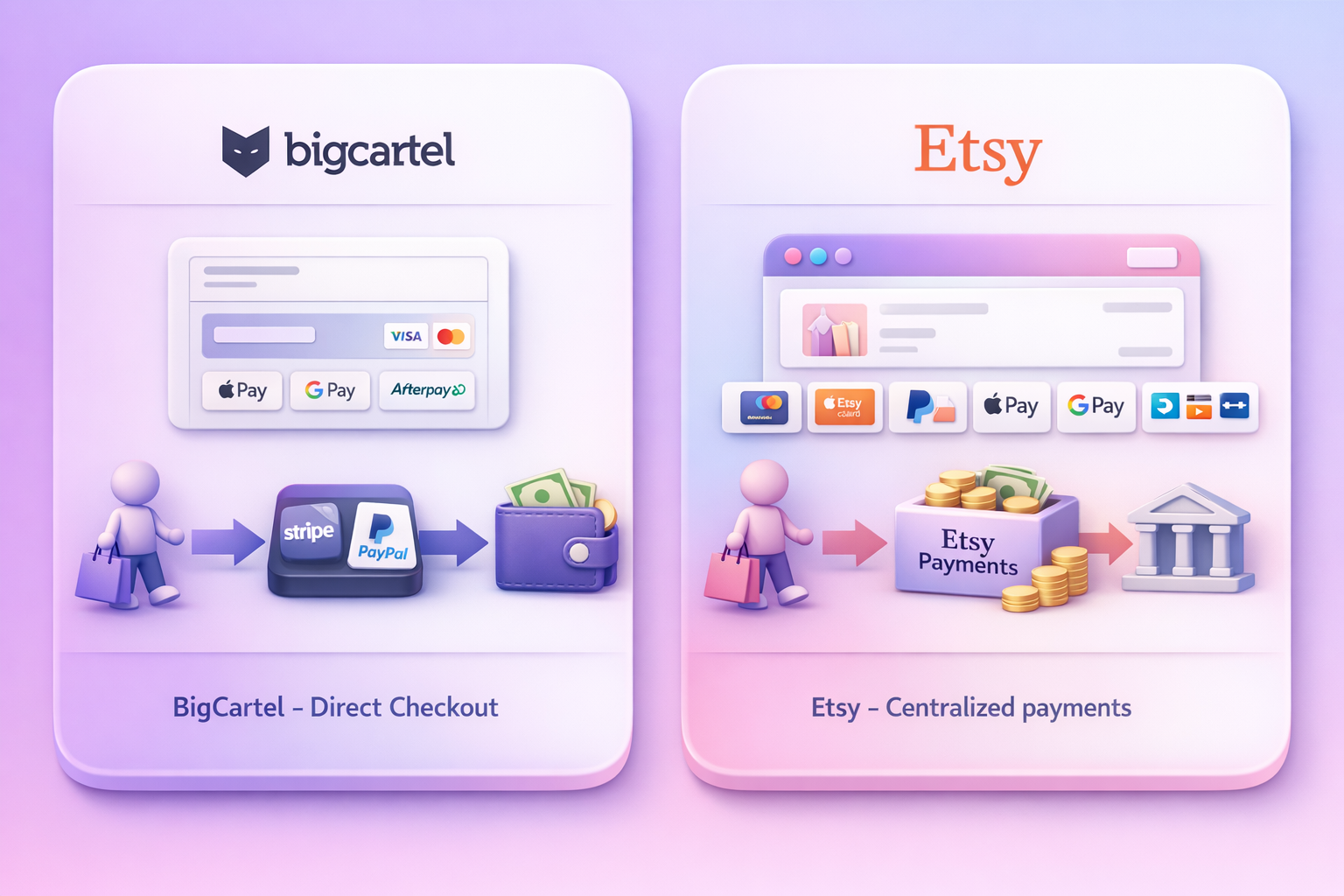
The checkout experience impacts conversion rates and your cash flow.
BigCartel checkout and payments
BigCartel tries to keep the checkout experience nice and simple for both seller and customer by integrating with popular payment processors.
- Payment Processors: BigCartel is primarily integrated with Stripe and PayPal. Sellers can link one or both to their shop.
- Buyer Experience: The customer checks out directly on the seller’s website, which is a significant advantage. If they’re using Stripe, they can pay using all the major credit cards, Apple Pay, Google Pay, and some “Buy Now, Pay Later” options (like Afterpay, Klarna) if the seller is on a paid plan.
- Seller Experience: The seller gets their funds – minus any fees – straight into the account set up with Stripe or PayPal; BigCartel doesn’t take a cut.
Etsy checkout and payments
Etsy has a streamlined checkout process that handles all payments through its own system, which can deliver a great customer experience but can be more complex for sellers.
- Etsy Payments: If you’re starting out and in an eligible country, you’ll likely need to use Etsy Payments, which acts as an intermediary, processing all payments before sending the funds to your bank account.
- Buyer Experience: Buyers have many payment options, including credit cards, Etsy Gift Cards, PayPal (integrated), Apple Pay, Google Pay, and regional payment methods such as Klarna and iDEAL.
- Seller Experience: Any funds from sales are deposited into a seller’s “payment account” on Etsy, minus applicable fees: listing, transaction, and payment processing. They can set up automatic payments to their bank account, daily, weekly, bi-weekly, or however suits them best
Day-to-day operations
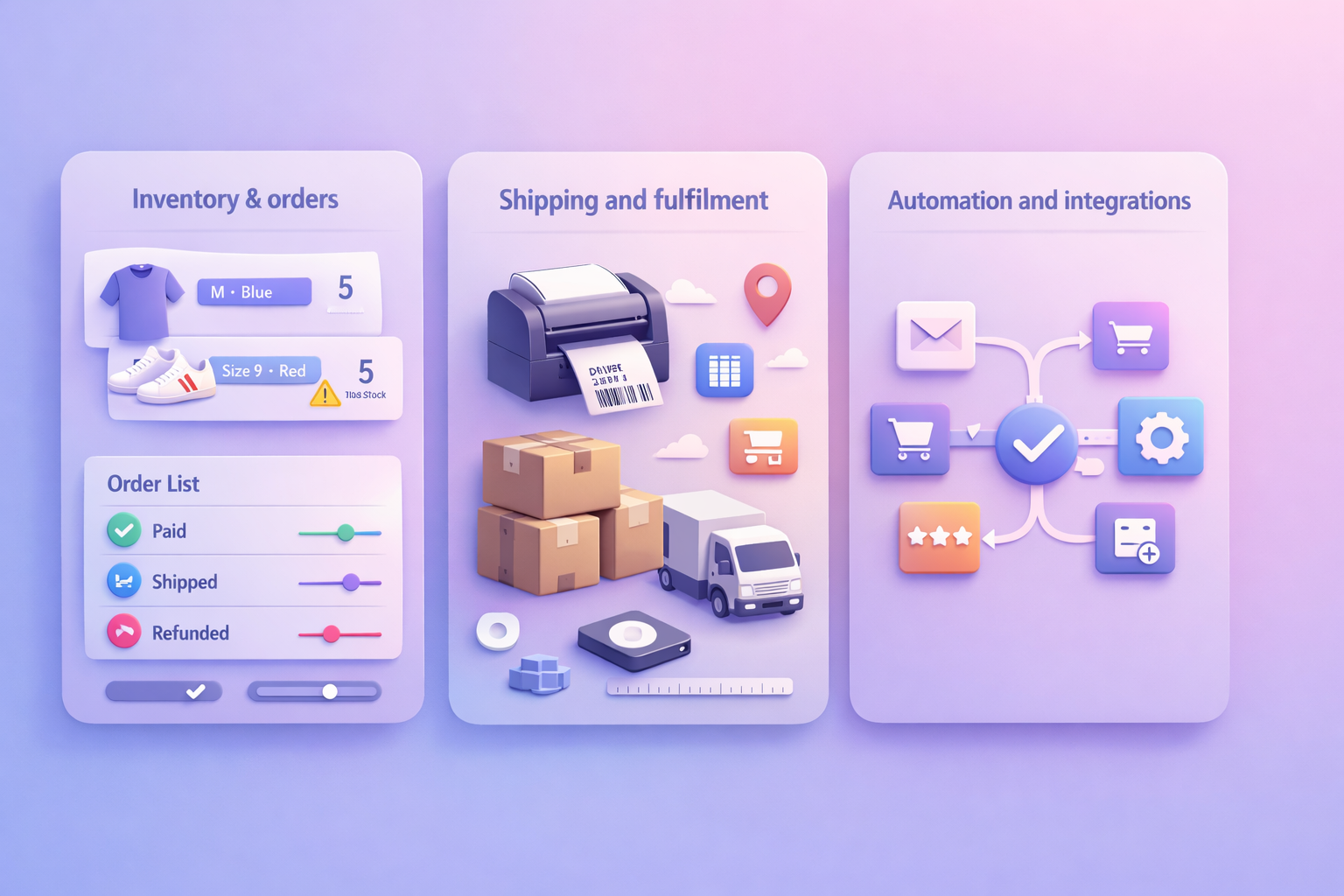
Running your store smoothly requires good tools for inventory, shipping, and workflow automation.
Inventory and order management
Inventory Tracking: BigCartel does basic tracking; mark items as “sold out” and adjust stock levels by hand if needed. Etsy does better tracking with options for variations and low-stock alerts.
Order Management: BigCartel has a simple order list with basic filtering, and sellers can print packing slips. Etsy has a more comprehensive dashboard with lots of status filters, shipping label integration, and partial refunds.
Shipping and fulfillment
Shipping Labels: BigCartel needs third-party apps (like ShipStation) or manual processing. Etsy has integrated shipping label purchasing (in the US, Canada, UK, and Australia) with discounts and auto-uploaded tracking numbers.
Shipping Profiles: BigCartel offers simple, customizable shipping cost settings for individual items or regions. Etsy’s got more advanced shipping profiles that can be applied to lots of listings at once, saving loads of time.
Calculated Shipping: BigCartel can’t do calculated shipping on its own. Etsy does, for US sellers, automatically figure out postage costs based on the item’s weight, size, and destination.
Automation and integrations
Built-in Automation: Big Cartel offers limited automation, such as abandoned-cart emails, which is available only on paid plans. Etsy has a little more built-in automation functionality with auto-review requests, the function to establish sales events, and auto-renewal of listings.
Key Integrations: BigCartel integrates with major applications, including Mailchimp (email marketing), ShipStation (shipping), Stripe/PayPal (payments), and Printful.
Etsy has also been expanding its ecosystem by integrating with many tools, building its core system to the point where there may be less need for integrations.
Support, rules, and risk
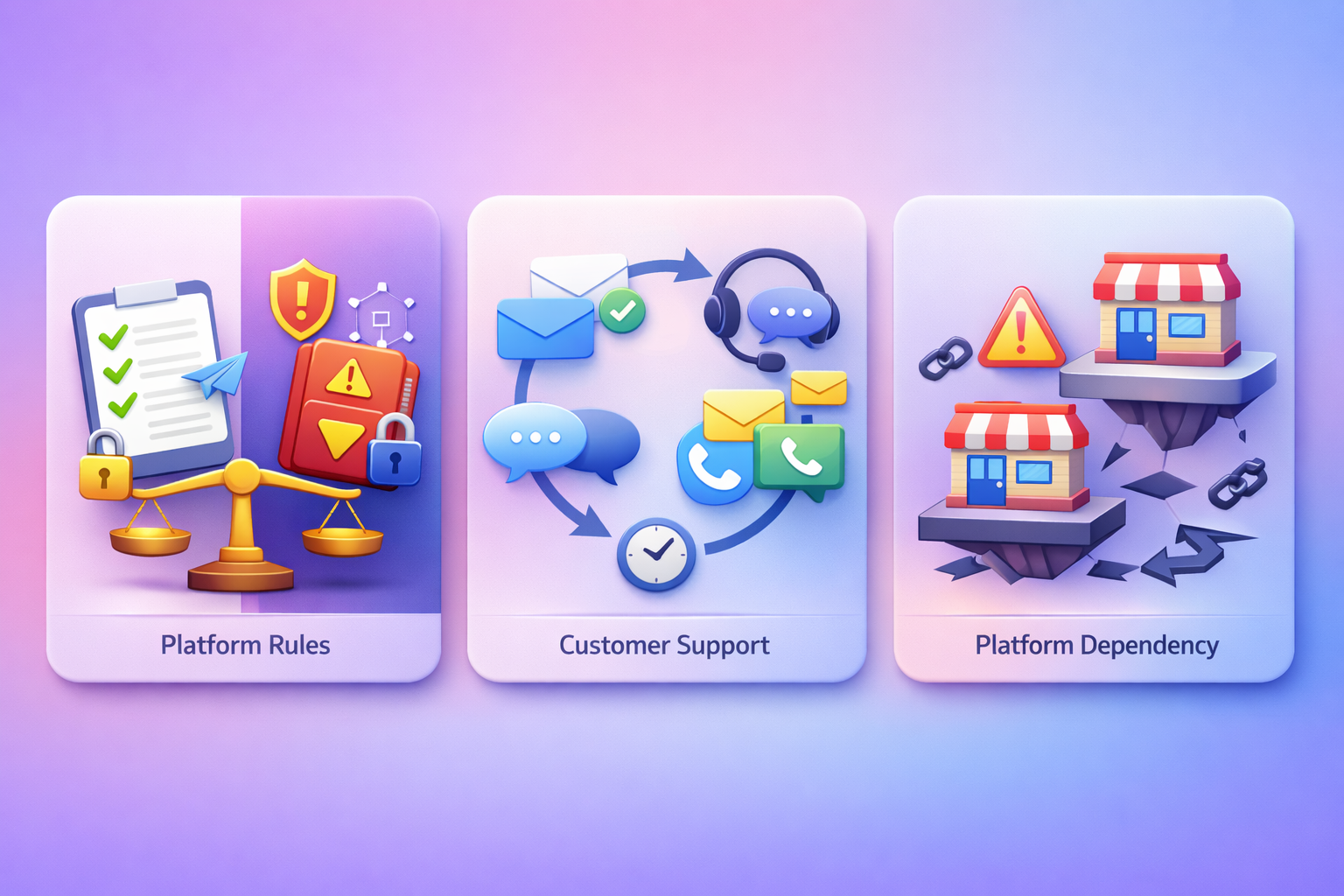
Both BigCartel and Etsy provide support and enforce rules, but they differ significantly in their approaches and in the level of risk sellers face from platform dependence.
Platform rules and enforcement
BigCartel is very straightforward when it comes to policies – as long as you’re not selling anything illegal or violating the basic terms, you’ve got a lot of freedom. BigCartel doesn’t do too much enforcing; it’s more of a “creator-friendly” policy.
Etsy is a different story; strict marketplace policies require sellers to follow the rules. The core rules state that items must be genuinely made by the seller, vintage, or creative supplies.
Etsy uses a mix of AI and humans to verify that sellers are complying with the rules; if they’re not, there are stiff penalties.
Customer support experience
BigCartel offers support primarily via email, which is only available on weekdays. The support team is generally pretty helpful and responsive, especially during business hours.
Etsy offers a wide range of support options, including email, live chat, and phone, which makes it easier to get help right away.
While the options are a plus, some sellers have noted that support can come across as formulaic or not particularly helpful for more complex problems.
Platform dependency risk
BigCartel carries a low platform dependency risk. The seller owns the brand, the website, and the customer list. If the seller ever decides to leave BigCartel, they can export their data and move to another e-commerce platform with minimal disruption to their business and customer relationships.
Etsy carries a high risk of platform dependency. Sellers are building their business on “rented land.” An Etsy shop can be shut down at any time, for any reason (e.g., policy changes, perceived violations, or algorithm shifts), which can instantly erase a seller’s entire income stream and customer base.
Which platform should you choose
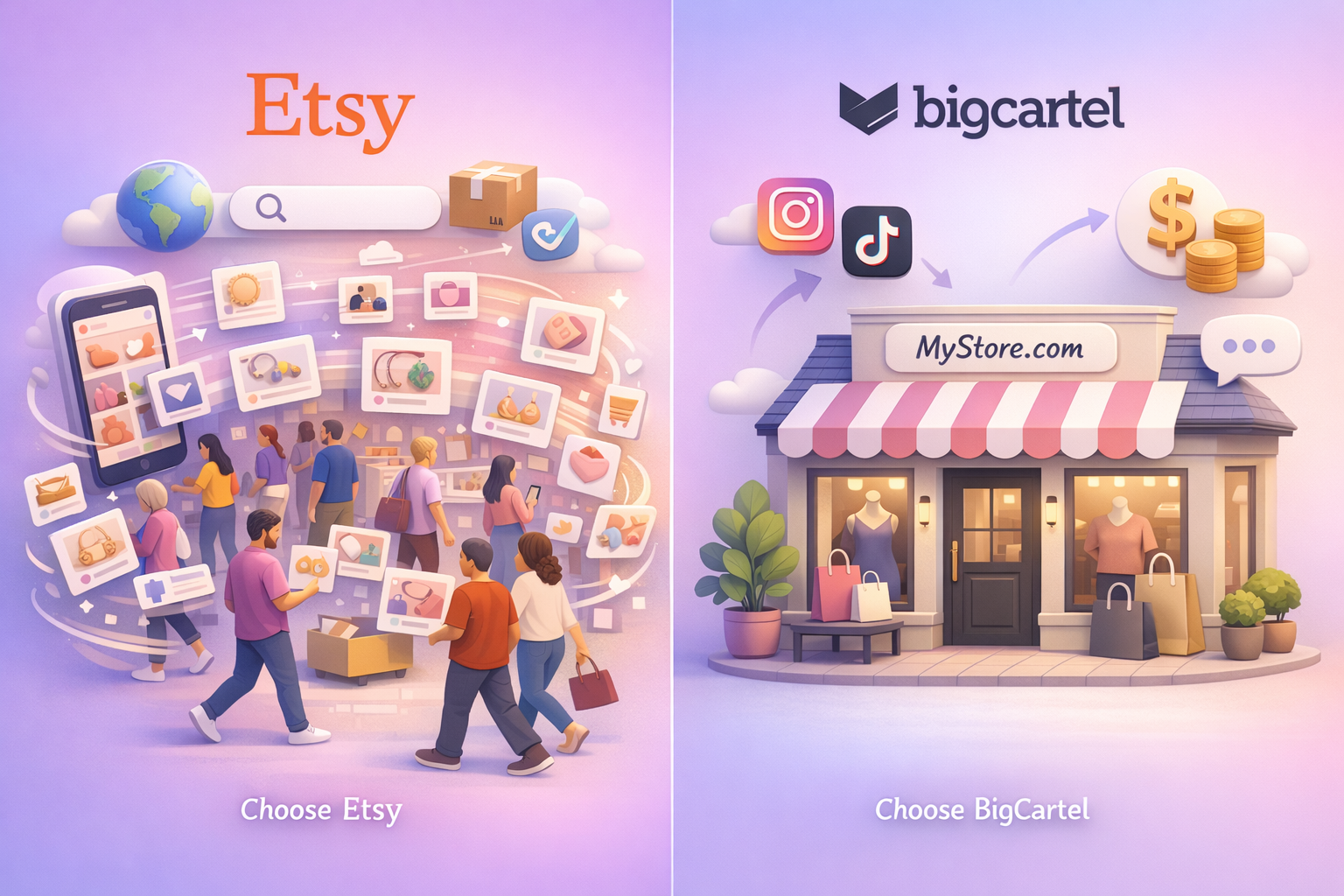
In 2026, the choice between BigCartel and Etsy depends on whether you value market access or brand independence. Both platforms have evolved to include more AI-driven tools, but their core philosophies remain distinct.
Choose Etsy if:
- You are a new seller without an existing social media audience. Etsy is the better choice because it provides immediate access to millions of shoppers through its internal search engine.
- You sell high-volume, low-margin items that make it easier to test many different designs or vintage finds without a large upfront subscription cost.
- You want a “set it and forget it” setup, such as global tax collection, calculated shipping, and mobile app optimization, allowing you to focus purely on creating products.
- You prioritize mobile discovery where buyers browse for inspiration rather than searching for a specific brand.
Choose BigCartel if:
- You are an established artist or influencer with a loyal following on platforms such as Instagram or TikTok. BigCartel lets you keep a much higher percentage of your sales by avoiding Etsy’s 6.5% transaction fee.
- Brand identity is your top prioritywhere you want your store to look like a professional, independent boutique rather than a standard marketplace page.
- You want predictable monthly costs, as BigCartel uses a flat subscription model, you won’t be surprised by “success fees” or rising advertising costs as your sales grow.
- You want to “own” your customers and maintain direct relationships with your buyers, without the strict communication rules imposed by marketplaces.
Choose both if you’re strategic. Many successful sellers use Etsy for discovery and customer acquisition, then drive repeat customers to their BigCartel store for higher-margin sales.
All your reviews in one place
Collect reviews, manage every response, and display them where they matter most.Final verdict
BigCartel wins for brand control and long-term profitability. Etsy wins for immediate sales and beginner accessibility.
The smartest move? Start on Etsy to validate your products and get sales quickly. Once you have traction and an audience, launch a BigCartel store to achieve higher margins and greater brand independence.
Use both platforms strategically; they complement each other well.
Your success depends less on which platform you choose and more on your product quality, customer service, and marketing consistency.
Frequently asked questions
Yes. Many sellers use both. BigCartel lets you import listings from Etsy, but you must track inventory to prevent overselling.
Etsy. Built-in traffic helps you get sales faster. BigCartel’s free plan works, but you must bring your own visitors.
It depends on your location. Both platforms let you start without a license, but local tax and business rules still apply.
Yes on BigCartel, even on the free plan. On Etsy, you need the Pattern add-on, and the store still runs on Etsy’s system.

Krunal