3 min
3 min 
Google’s Product Reviews updates have completely turned the way the web evaluates trust and expertise on its head.
What started in 2021 as a way to weed out thin affiliate content has now evolved into a constant review system that actively assesses every type of recommendation, from gadgets to destinations, in real-time.
Below is a comprehensive rundown of how Google’s Product Reviews updates have unfolded, including the changes made with each update and why this evolution remains essential for every publisher, affiliate, e-commerce site, and local SEO strategist, as well as anyone involved in Google reviews.
Timeline of Google’s Product Reviews updates
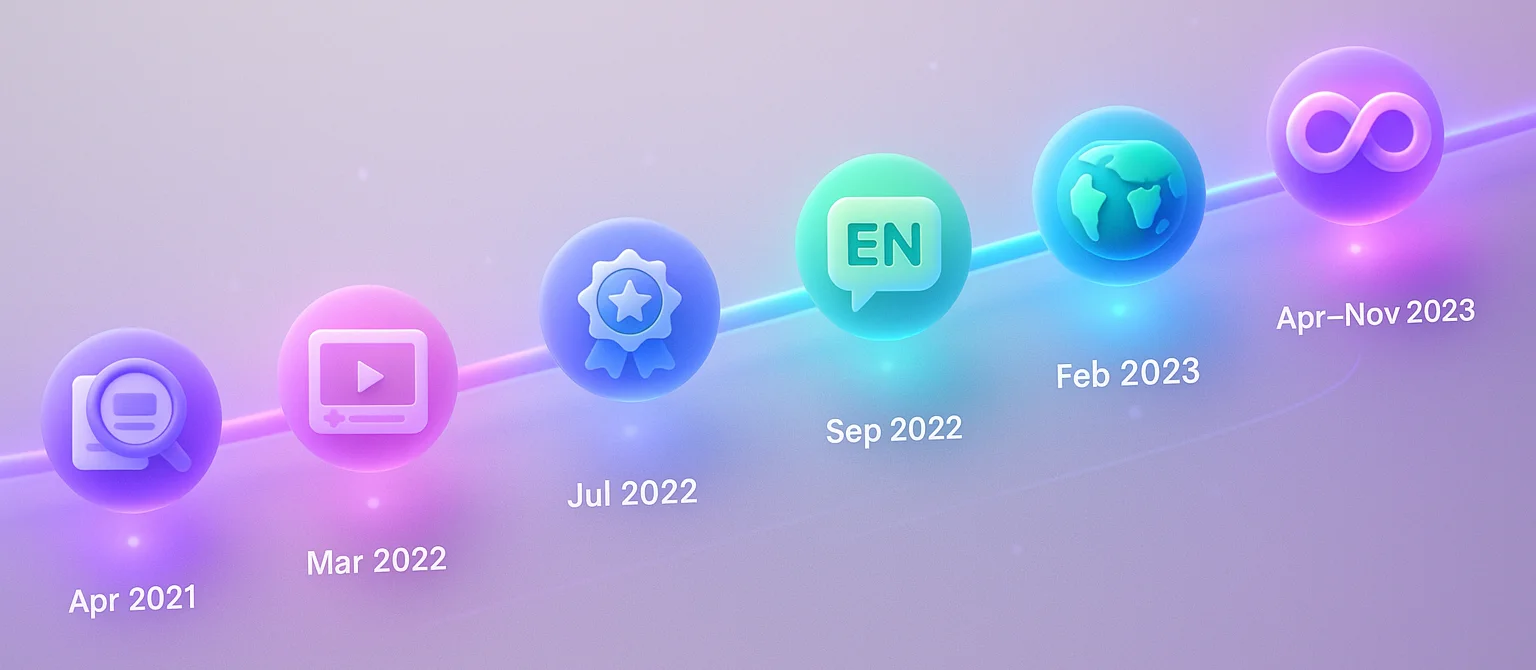
Google’s Product Reviews updates evolved from targeting thin affiliate reviews in 2021 to continuously evaluating all review content.
Here’s how each update changed the system.
April 2021: The very first product reviews update
Google first launched its Product Reviews Update on April 8, 2021.
The goal was to give in-depth, hands-on reviews a leg up over summary content or copies of the same old thing.
What changed
- The algorithm began to favor reviews based on firsthand experience and original research.
- Pages were no longer just judged on their overall quality, but on the quality of individual sections.
- Thin affiliate content that only repeated specs or used manufacturer descriptions started to drop down the rankings.
The impact was that many affiliate sites experienced ranking volatility very similar to that of a core update.
Sites that actually tested the products and shared measurable results started to make some gains; those relying on rewrites saw their traffic decline.
December 2021: Second update
Rolled out over December 1 – 21, 2021.
Focus: A refinement of the system based on feedback and stronger signals of authenticity.
What changed:
- Multimedia evidence became a ranking factor, especially photos or videos that showed the reviewer actually using the product.
- Multiple seller links were encouraged to give readers more unbiased buying options.
Result: Volatility jumped quite a bit compared to April. Retail and travel niches were significantly impacted, while health and finance saw less disruption.

All your reviews in one place
Collect reviews, manage every response, and display them where they matter most.
Start Free →March 2022: Third update
Released over March 23 – April 6, 2022.
Goal: Improve Google’s ability to detect expertise and quality.
What changed
- Added signals for benefits, drawbacks, and real-world performance.
- Confirmed inclusion of ranked lists and comparison reviews under the same quality checks.
Impact: Described as one of the most significant updates since June 2021, causing quite a bit of movement across affiliate and comparison sites.
July 2022: Fourth update
Live over July 27 – August 2, 2022.
Goal: Refresh the existing systems.
What changed: No new ranking factors, just fine-tuning of the existing ones.
Community response: Mild volatility; rollout was completed in record time.
September 2022: Fifth update (English-language focus)
Released over September 20-26, 2022.
Focus: Continuously improving English reviews.
What changed
- Overlapped with a Core Update and the Helpful Content Update, making attribution pretty tricky.
- Confirmed that the system should only affect review-related content.
Impact: Lower volatility than previous rounds, but high confusion due to overlapping systems.
February 2023: Sixth update (International expansion)
Live over February 21 – March 7, 2023.
Goal: Expand the system globally.
What changed
- Added 10 more languages, including Spanish, German, French, Italian, Vietnamese, and more.
- More substantial volatility was observed, with Semrush tracking a 150% increase compared to July 2022.
- The highest impact was seen in the beauty, fitness, shopping, and leisure categories.
April 2023: Reviews system expansion (Beyond products)
Rolled out over April 12-25, 2023.
Goal: Broaden the scope beyond physical products.
What changed
- Google dropped the word “Product” and renamed it the Reviews System.
- Now covers services, businesses, destinations, and media (movies, shows, etc.).
- Documentation replaced “product” with “thing” and “shoppers” with “people”.
As a result, review display tools like the Google reviews widget started gaining more importance for brands that collect and showcase feedback across products, services, and experiences.
Impact: Non-product review sites (travel, SaaS, entertainment) saw sudden ranking shifts.
November 2023: Transition to continuous updates
Released from November 8 to December 7, 2023.
Goal: Move from periodic to ongoing updates.
What changed
- Google announced this would be the last public Reviews Update.
- The system now improves continuously rather than via batch rollouts.
Impact: Faster reflection of improvements but harder attribution. Updates can now affect rankings at any time.
2024-2025: Emerging changes and policy moves

The review system is now part of Google’s live ranking ecosystem. Key shifts include:
Integration with core updates
All 2024 core updates (March, August, November, and December) refined review signals, with a particular focus on low-quality or AI-generated review content.
Spam and reputation enforcement
Google’s SpamBrain upgrades and the Site Reputation Abuse Policy (May 2024) were implemented to combat parasitic SEO and manipulated third-party reviews.
AI overviews and reviews visibility
By 2025, Google’s AI Overviews feature began surfacing review snippets directly in SERPs, especially in entertainment and e-commerce queries.
Gemini powered review filters (May 2025)
Improved Business Profile review filters now detect fake and artificially inflated feedback to help prevent suspicious businesses from listing their products.
The continuous refinement
Since late 2023, Google has effectively taken its foot off the pedal when it comes to individually verifying review updates.
Instead of receiving a thumbs up or down, sites are now subject to an ever-changing interpretation of E-E-A-T and near-constant system checks.
All your reviews in one place
Collect reviews, manage every response, and display them where they matter most.
Start Free →Final Thoughts
Google’s Product Reviews system has evolved from a single-purpose algorithm to a live, ongoing process that shapes visibility across the internet.
Using Google review management software helps businesses stay aligned with these changes by ensuring every review they publish or display reflects real experiences.
Frequently asked questions
Review gating is when businesses only ask satisfied customers to leave reviews, which can lead to biased feedback. Google’s policies prohibit this because it prevents honest, balanced reviews.
Yes. If Google detects review gating, it can remove reviews, lower your rankings, or even suspend your Google Business Profile.
Simply ask all customers for feedback, without filtering or pressuring them. Provide a direct and easy way for them to leave a review, but don't offer rewards for positive reviews.
Use a review management tool like WiserReview to automate requests to all customers, manage feedback effectively, and ensure compliance with Google’s guidelines.
Encourage honest reviews, respond to all feedback, and focus on customer service. Use tools like WiserReview to streamline review collection and management.

Krunal