8 min
8 min 
Magento continues to support high-volume e-commerce sites, including those that require full control over functionality, data, and customization.
The retail count, revenue share, and enterprise use are among the reasons businesses rely on Magento.
The 2026 data provides insight into how Magento supports different geographic regions, industries, and business sizes. These statistics indicate where growth in use is occurring and where the slowdown has begun.
This article lists 35 of the latest Magento statistics that answer common questions fast. Each stat highlights usage, market position, and business impact.
If you want a quick, data-based view of Magento’s current standing, the stats below give you that in minutes.
Top highlight
- As of 2026, Magento powers over 2,50,000 online stores worldwide.
- 20% of the top 1,000 US retailers trust Magento for its enterprise-level reliability.
- Germany leads regional adoption at 19.4% market share, followed by the US, holding 13% of all global Magento stores.
- 46% of shoppers on Magento sites complete their purchases via mobile devices.
- The platform facilitates an estimated $173 billion in annual Gross Merchandise Value (GMV) as of 2025-2026.
- 60% of new developments utilize a headless architecture.



All your reviews in one place
Collect reviews, manage every response, and display them where they matter most.
Global Magento market overview
Magento (Adobe Commerce) currently ranks as the third most-used e-commerce platform globally by market share, holding a strong position in the mid-market and enterprise segments.
Current Magento adoption & market share
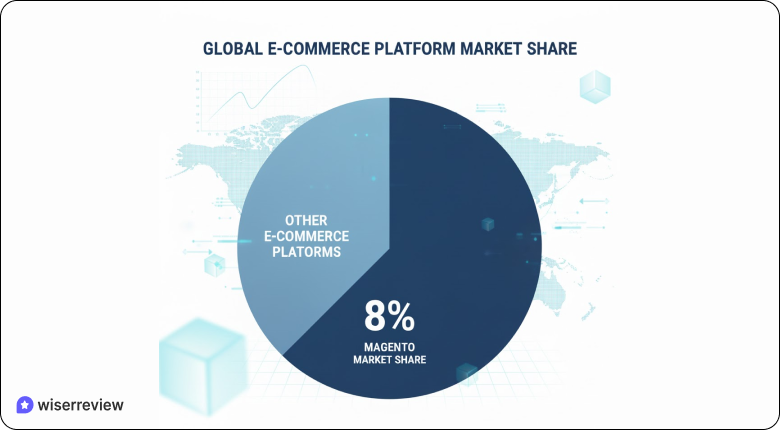
Magento is widely used by midsize and enterprise e-commerce businesses that require more complex customization and scalability. Magento’s market share remains robust in geographies with high volumes and B2B e-commerce businesses.
1. As of late 2025/early 2026, Magento maintains an approximate 8% share of the global e-commerce platform market.
2. There has been a significant migration to the newer platform, with over 70% of active sites now running on Magento 2.
3. The global B2B e-commerce market is projected to reach $36 trillion by 2026, a segment where Magento excels.
Magento’s market position in the ecommerce platform landscape
It is still the number one B2B e-commerce platform, as B2B stores on Magento have seen an average order value that is 2.5 times higher compared to their B2C stores.
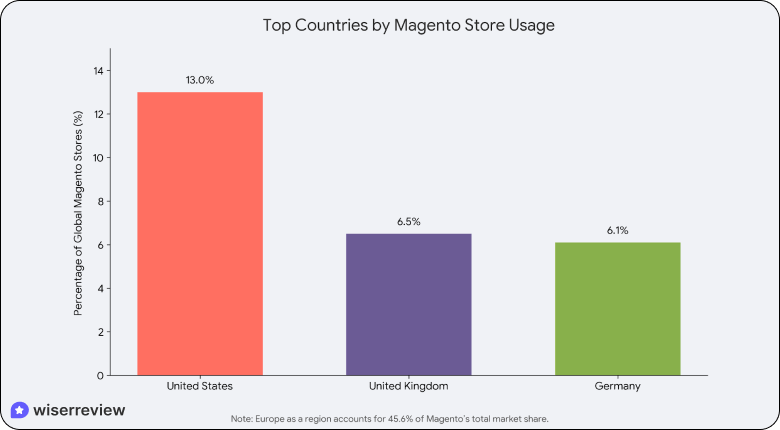
4. The United States leads usage with 13% of all stores, followed closely by the UK (6.5%) and Germany (6.1%).
5. Europe is the leading global region for Magento usage, accounting for approximately 45.6% of its total global market share.
Magento revenue, growth, and commerce metrics
In 2026, Magento (Adobe Commerce) generates $173 billion in annual Gross Merchandise Value (GMV) and maintains a stable global market share by focusing on enterprise-level scalability and a high return on investment (ROI) for its users.
Global ecommerce revenue influenced by Magento
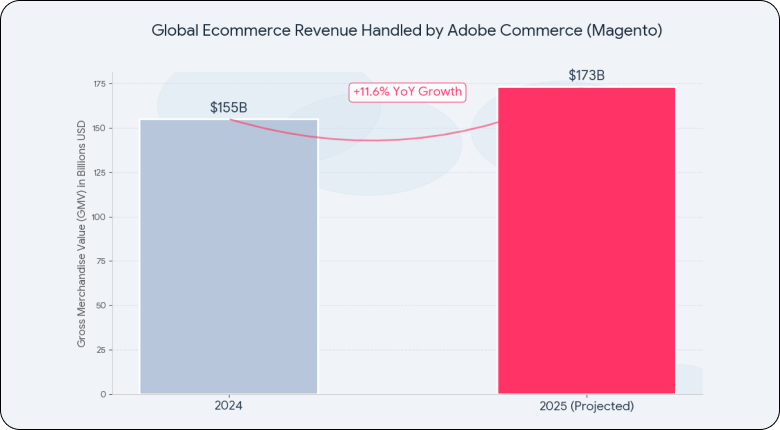
6. Adobe Commerce is projected to have an 11.6% year-over-year growth.
7. The platform demonstrated its capacity by processing over $6.2 billion in GMV on Black Friday 2024.
8. Businesses using the platform see an average of 29% higher revenue, with some reaching an 80% boost.
Adobe Commerce cloud adoption trends
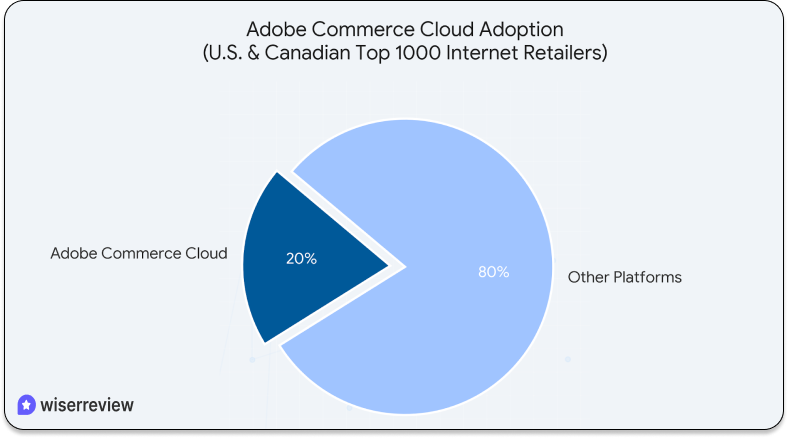
9. Adoption is strong among major retailers, with about 20% of the U.S. and Canadian Internet Retailer Top 1000 using the platform.
10. Over 70% of active sites have moved to Magento 2 and Adobe Commerce Cloud from Magento 1.
11. The platform is a top choice for B2B, where stores have an Average Order Value (AOV) of $122.
Magento performance & technical statistics
In 2026, Magento (Adobe Commerce) performance strategies are defined by a significant shift toward Hyvä themes and headless architectures, which have become the standard for meeting Google’s strict Core Web Vitals requirements.
Speed, core web vitals & mobile performance
A well-optimized Magento 2 store in 2026 averages a load time of 2.2 seconds, while cloud-hosted enterprise stores achieve median times of 2.7 seconds on desktop.
The Hyvä theme has become a dominant frontend solution, reducing average page load times to <1.2 seconds (compared to 4s+ for the legacy Luma theme) and cutting Time to First Byte (TTFB) by up to 65%.
Magento 2 security & update adoption

12. 90% of Magento stores use SSL/TLS certificates, showing a strong basic security setup across the ecosystem.
13. Adobe has released over 116 security patches and updates for Magento 2 since its major releases, reflecting ongoing security improvements.
14. Magento 2.4.8 (released April 2025) included significant security enhancements and 497 core bug fixes, showing growth in update frequency and quality.
Magento extensions, themes & ecosystem data
The Magento ecosystem’s strength comes from its extensive marketplace and active developer community.
Magento marketplace statistics
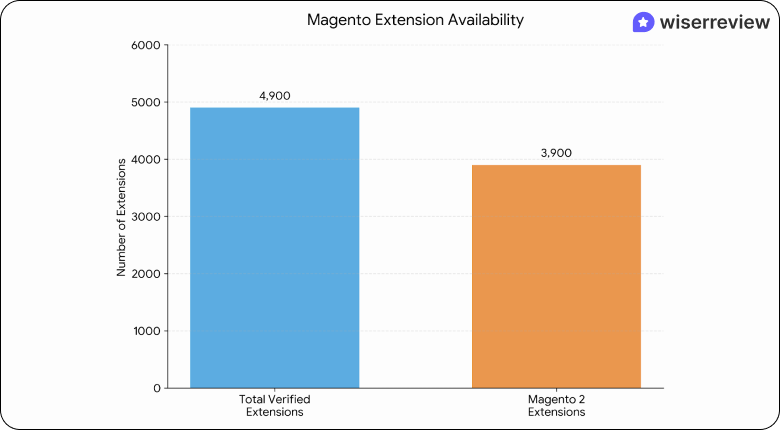
15. The Adobe Commerce Marketplace currently offers over 4,900 verified extensions.
16. Separate sources list about 3,900 Magento 2 extensions on the marketplace for 2025.
17. Over 1,365 verified vendors contribute to the official app store, ensuring a diverse range of payment, marketing, and logistics solutions.
Developer ecosystem & community
The platform is supported by an extensive network of over 300,000 active developers worldwide.
The official Adobe forum for Magento Open Source has nearly 483,000 active members, providing a deep knowledge base for troubleshooting and innovation.
Demonstrating ongoing developer interest, the Magento Open Source core is downloaded approximately 5,000 times every day.

All your reviews in one place
Collect reviews, manage every response, and display them where they matter most.
Start Free →Magento SEO & marketing performance insights
Fast forward to 2026, and Magento (Adobe Commerce) continues to deliver strong SEO and marketing performance, especially for large enterprise stores.
Organic traffic insights
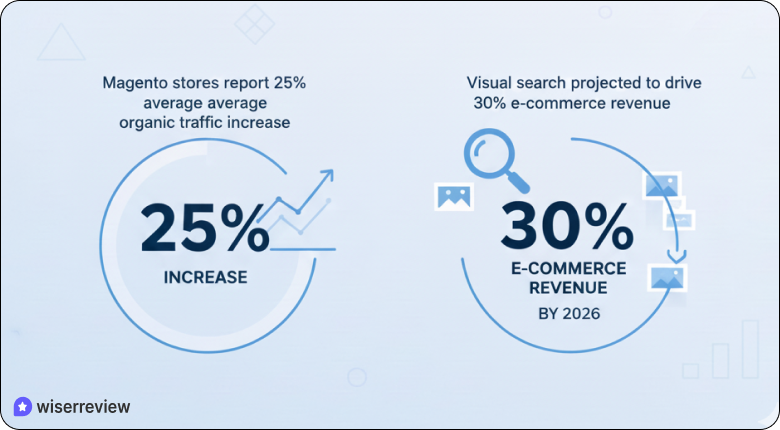
18. Magento stores utilizing advanced SEO tools report an average 25% increase in organic traffic.
19. With high-quality image tagging, visual search is projected to drive 30% of e-commerce revenue by 2026.
20. Implementing rich snippets on product pages results in a 20% higher click-through rate (CTR).
Conversion rate benchmarks for Magento stores
Conversion rates vary by industry, but Magento stores typically target 2-4% as a healthy benchmark.
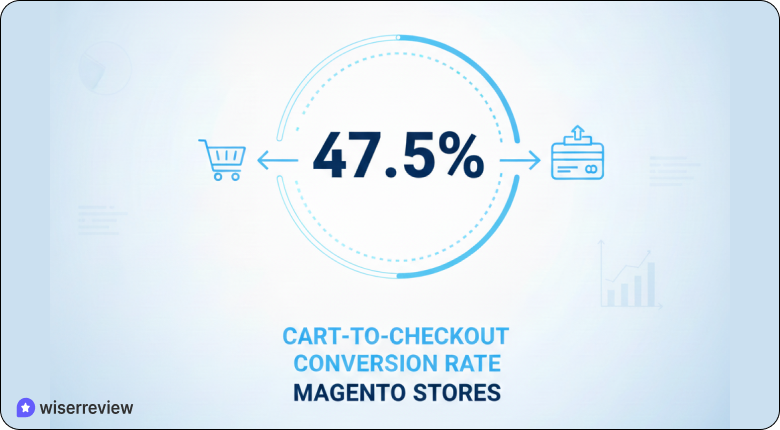
21. Well-optimized Magento stores achieve a strong 47.5% cart-to-checkout conversion rate, significantly outperforming many competitors.
22. Integrating product reviews and social proof tools can increase conversion rates by up to 15%.
23. After rebuilding the Adobe Commerce site with Hyva, USA saw 40% higher conversions.
Magento B2B statistics
When it comes to complex B2B e-commerce, Magento (Adobe Commerce) remains the leader, driven by its advanced self-service tools and rapid integration of AI-driven procurement features.
Magento as a B2B ecommerce leader
Magento (now Adobe Commerce) is widely regarded as a top-tier platform for complex, enterprise-level B2B e-commerce.
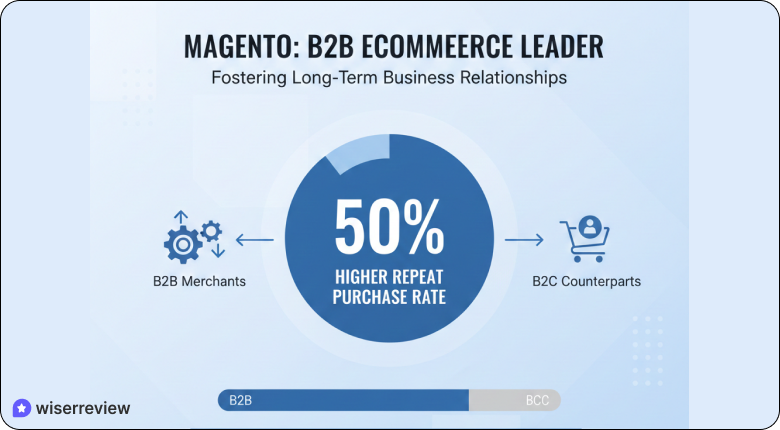
24. Magento B2B merchants experience a 50% higher repeat purchase rate compared to B2C counterparts, demonstrating the platform’s effectiveness in fostering long-term business relationships.
25. On the broader landscape, the global B2B e-commerce market is projected to reach $36 trillion by 2026, growing at a 14.5% CAGR.
B2B Purchasing Trends
2026 marks the rise of AI payment agents that dynamically resolve payment failures for large-scale orders.
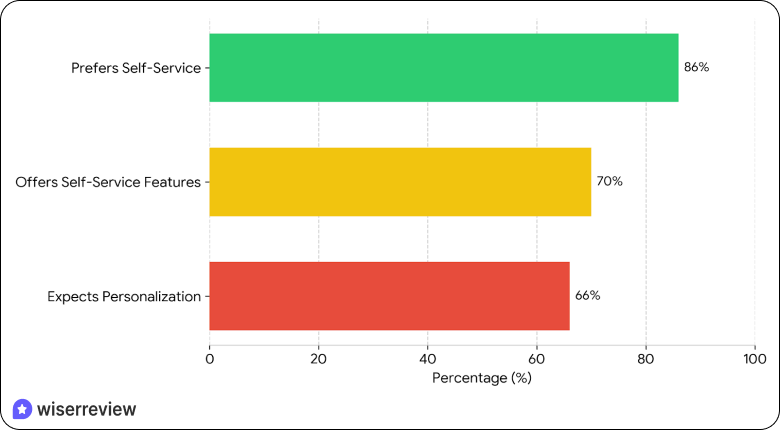
26. Approximately 70% of B2B Magento stores now offer advanced self-service features for reordering and tracking, as 86% of customers prefer managing orders without sales representative intervention.
27. Nearly 66% of B2B buyers now expect a fully personalized buying experience, surpassing expectations in their personal lives.
Magento payments & checkout statistics
Checkout optimization directly impacts revenue. Magento supports flexible payment integration and checkout customization.
Payment methods & processing insights
Magento has got you covered when it comes to payment gateways, with integrations available for all the big names like PayPal, Stripe, Braintree, Klarna, Authorize.Net, Square, Mollie, Amazon Pay, and Google Pay.
Merchants have the flexibility to accept payments however customers prefer.
28. Mobile wallets (like Apple Pay and Google Pay) are already accounting for 37% of US online transaction value, and are on track to reach a massive 52% by 2027.
Magento also supports BNPL (Buy Now, Pay Later), with options from providers like Klarna that can significantly boost checkout conversion rates for higher-ticket purchases.
Cart abandonment on Magento stores
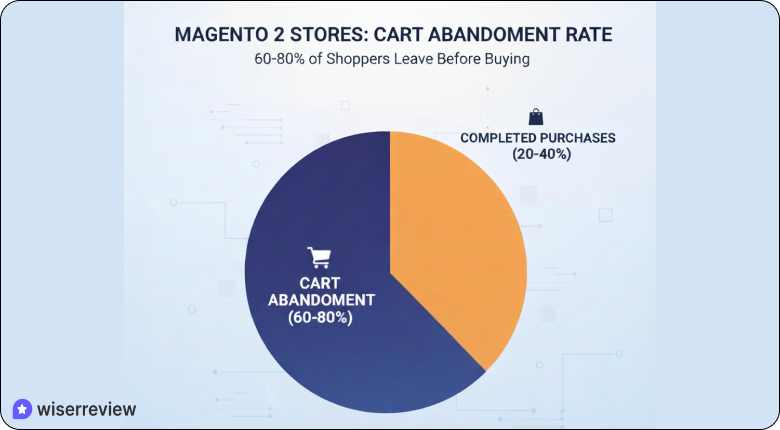
29. The average cart abandonment rate for Magento 2 stores tends to sit somewhere in the range of 60% to 80% – which is basically saying that a lot of shoppers are adding stuff to their carts but then deciding to leave without buying.
30. On the other hand, your chances of recovering lost revenue through abandoned cart email campaigns are pretty good – about 10% – and even better if you send a few follow-up emails.
WiserReview is a great tool for helping you recover abandoned carts by displaying genuine customer reviews right at the points where people are most likely to decide to buy, and when they see that other people have been happy with the product, they’re more likely to trust you and complete the purchase.
All your reviews in one place
Collect reviews, manage every response, and display them where they matter most.
Start Free →Magento hosting & infrastructure statistics
Magento’s hosting landscape is defined by a clear divide between high-touch, self-managed environments for flexibility and fully managed cloud solutions for enterprise-grade scalability.
Cloud vs. on-premise hosting distribution
31. By 2026, cloud dominance continues to grow, with an estimated 80% of stores expected to favor cloud environments by 2030 due to performance and regulatory benefits.
32. This model is the default for enterprises seeking 99.99% uptime SLAs and automated scaling for peak events like Black Friday.
Cost benchmarks
Magento Open Source: This option is free to use, but getting a basic store up and running can still cost $10,000 to $60,000+.
Adobe Commerce (paid license): The annual license starts at around $22,000, but can go up to $125,000+ if you’re a high GMV business.
Adobe Commerce Cloud: If you opt for cloud hosting, costs range from $40,000 to $190,000+ per year, depending on your store’s annual gross sales and the tier you choose.
Magento migration & upgrade statistics
Migration from Magento 1 to Magento 2 remains a critical consideration for merchants still running the unsupported version.
Migration from Magento 1 to Magento 2
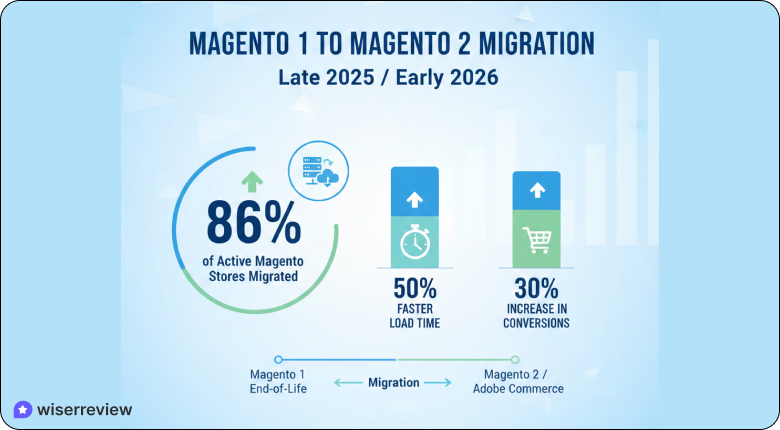
33. As of late 2025/early 2026, over 86% of active Magento-based stores have migrated to Magento 2 or Adobe Commerce.
34. Migrating to Magento 2 typically delivers a 50% faster load time and can drive a 30% increase in conversions.
35. Despite the end-of-life in 2020, approximately 14% of e-stores still run on Magento 1, often due to high customization complexity or perceived migration costs.
Replatforming trends
Some merchants choose to migrate to alternative platforms rather than upgrading to Magento 2.
Common destinations include Shopify Plus, BigCommerce Enterprise, and Salesforce Commerce Cloud.
However, businesses seeking enterprise-grade customization, control, and scalability typically remain within the Magento ecosystem, upgrading to Magento 2 or Adobe Commerce rather than replatforming entirely.
Regional & industry-specific Magento insights
Magento’s geographic and industrial footprint reflects its status as a high-performance solution for mature markets and complex verticals.
Geographic distribution
| Country | Estimated Magento Stores (2025–2026) | % of Global Magento Sites | Regional Market Characteristic |
|---|---|---|---|
| United States | 42,965+ | 11% – 13.4% | Largest Magento market globally; powers about 20% of top 1,000 retailers |
| United Kingdom | 10,300+ | 6.4% – 7.8% | Key European hub for large-scale Magento deployments |
| Netherlands | 8,990+ | 5.4% – 6.9% | Very high adoption rate compared to population size |
| Germany | 8,160+ | 6.1% – 6.2% | Strong preference for B2B, multi-store, and ERP-heavy setups |
| Italy | 4,390+ | 2.7% – 3.3% | Growth led by fashion, luxury, and premium retail brands |
| Brazil | 3,760+ | 2.4% – 5.6% | Leading emerging market for enterprise open-source commerce |
Industry breakdown
Magento is a preferred choice for industries requiring deep customization, such as Home & Garden and Fashion, which often involve complex product attributes and high SKU counts.
| Industry Vertical | % Share of Magento Stores | Notable Enterprise Examples |
|---|---|---|
| Home & Garden | 8.6% – 22.4% | Cox & Cox, Temple & Webster, Utility Design |
| Fashion & Apparel | 6.4% – 15.0% | Paul Smith, Christian Louboutin, END. Clothing |
| Business & Industrial | 5.1% – 8.0% | Large B2B wholesalers and manufacturing distributors |
| Electronics & Tech | 4.7% – 12.0% | HP Home, Canon, Nothing.tech |
| Food & Beverage | 4.3% – 18.0% | Coca-Cola (regional), Nestlé, Heinz |
| Health & Beauty | 4.1% – 10.0% | Lookfantastic, Feelunique, Cosme-de.com |
Wrap up
Magento remains a strong choice for businesses that need scale, flexibility, and deep control. The 2026 data shows it still plays a significant role in enterprise and B2B ecommerce.
While growth has slowed in some regions, Magento continues to lead in complex use cases, high GMV stores, and advanced customization. Cloud adoption, headless builds, and B2B features keep the platform relevant.
These statistics show where Magento stands in 2026 and how it is being used across regions, industries, and business models.
For brands that rely on scale, customization, and B2B capabilities, the numbers explain why Magento remains a serious platform choice.
Also see:
Frequently asked questions
Approximately 250,000 live websites globally use Magento (Adobe Commerce), including roughly 20% of the top 1,000 US retailers.
Costs vary by scale: basic open-source setups start around $25,000/year, while enterprise-level Adobe Commerce Cloud solutions typically range from $150,000 to over $500,000/year, depending on revenue.
Yes, Magento remains the #1 B2B e-commerce platform worldwide, with B2B users reporting average order values (AOV) 2.5 times higher than standard B2C stores.
The Hyvä theme and Headless (API-first) architectures have become the 2026 industry standards.

Krunal